Is a Reverse Osmosis System Worth It? Test the Water First
"Worth it" has no answer in the abstract, because reverse osmosis is a narrow tool pointed at one category of material in water: the dissolved fraction, the part that has gone into solution and will slip through any screen or cartridge on the market. A household whose supply carries very little of that fraction can install a full system, maintain it faithfully, and notice almost nothing at the glass.
Quick Answer: Reverse osmosis works on dissolved material that a cartridge filter cannot catch. Whether a system earns its place under your sink depends on what a laboratory test and your utility's published water-quality report show is actually in the water.
So the buying question sits downstream of a testing question. Until you know what your water actually carries, from a laboratory that runs a sample off your own tap and from the annual water-quality report your utility publishes, every argument for or against a system is a guess dressed up as a decision. The equipment does the same physical work in every house. What differs is what goes into it.
Pressure, a Membrane, and a Drain Line
A reverse osmosis membrane is a sheet of thin-film composite material wound in a spiral around a center tube. Water arrives at that sheet under household line pressure, and the sheet passes water molecules while holding back most of the dissolved material among them.
The name describes a reversal. Left alone, osmosis moves water across a semipermeable barrier toward the side carrying more dissolved material, diluting it. Push hard enough on the concentrated side, and that flow runs backward: water crosses toward the dilute side, and the dissolved material stays behind. Household pressure is the push.
Whatever stays behind has to go somewhere. It cannot pile up against the membrane face without blinding it, so a second stream runs continuously across that face, sweeping the rejected material out to the sink drain. Two streams leave the membrane: product water headed for a storage tank, and reject water headed down the drain.
What a Membrane Holds Back and What Passes Through
The membrane sorts by size and by electrical charge, which is why it reaches things a filter cannot. Dissolved salts and minerals, metals carried in ionic form, sulfate, fluoride, and larger dissolved organic molecules are all rejected at the membrane surface as a matter of how that surface works. A cartridge filter catches particles; this catches solutes.
Nitrate is the exception on that list. It is a small ion carrying a single charge, and thin-film membranes hold those back less completely than double-charge ions like sulfate, so nitrate rejection runs materially lower than the rest. It is also the one health-driven number there, which is why a nitrate result goes back to the laboratory that ran it and to the utility before equipment is chosen.
Honesty runs the other direction too. Dissolved gases cross freely, since a gas in solution carries no charge and presents almost no size for the sheet to reject. Carbon dioxide is the common one, and it can leave product water tasting slightly sharp. Chlorine passes as well, and it does more than pass: free chlorine attacks thin-film composite material, which is why a carbon stage always sits ahead of the membrane.
Sediment and grit never reach the membrane in a working system, because a sediment cartridge upstream removes them first. The membrane gets credit for that catch, but the prefilter did the work.
A water bill that climbs with no change in habits, or a warm patch on a slab floor, belongs to leak diagnosis and has nothing to do with what is dissolved in the supply. Treatment addresses only what arrives at the tap already in solution.
The Storage Tank, the Drain Line, and That Slow Faucet
A membrane produces water at a trickle. Nobody would stand at a sink filling a pot from that trickle, so a small pressurized tank sits in the cabinet and collects product water between draws. Inside the tank, a rubber bladder separates stored water from a charge of compressed air. Filling the water side squeezes the air side; opening the dedicated faucet lets that compressed air push the stored water back out.
This explains the soft flow at a reverse osmosis faucet. The tank delivers on stored air pressure, and that pressure falls as the air expands behind the departing water, so the stream tapers off as you go.
It also explains the running you hear when nobody is drinking. Draw a glass, tank pressure drops, and an automatic shutoff valve opens the feed so the membrane starts producing again. The reject stream starts running the moment production starts, so the drain line is moving water for a good while after you filled one glass, then the valve closes when the tank is charged again.
The share of feed water sent to drain is not fixed. It moves with membrane type, incoming pressure, and water temperature, and it climbs as the membrane face fouls. Hard water pushes it up: calcium and magnesium reach saturation right at the membrane surface long before they would anywhere else in the plumbing, and the scale they leave forces the system to work harder for the same volume.
Where the Unit Lives and What It Actually Feeds
A residential system is point-of-use equipment. The housings, membrane, and tank are housed in the cabinet under the kitchen sink, and product water comes out through a small dedicated faucet on the sink deck, separate from the main tap.
That faucet is within the system's reach. Every other fixture still delivers the untreated supply: showers, tubs, laundry, hose bibs, and the hot side of the same kitchen sink.
The refrigerator question comes up in almost every conversation. A line can be run from the product side across to an ice maker or door dispenser, and two things follow. Every ice cycle and every dispensed glass now pulls from the same small tank the sink faucet draws from, so the tank spends more of its day refilling. And the long run of small-diameter tubing loses pressure over its length, so ice production slows and cubes can come out small or hollow.
A drinking-water unit also sits on the cold line and never sees the water heater, so scale on a heating element or a spent anode rod stays exactly the problem it was before the system went in. The membrane's territory ends at the one faucet it feeds.
Prefilters on One Clock, the Membrane on Another
Real maintenance on these systems is staged, and the stages run on different calendars. Ahead of the membrane sit a sediment prefilter and one or more carbon prefilters. Behind the tank sits a final carbon polishing filter that catches routine storage taste, though water left standing for weeks overruns it. Those cartridges come out at relatively short intervals. The membrane lasts far longer, precisely because the cartridges ahead of it are consumed first.
Write the date the prefilters were last changed on the filter housing in permanent marker. Most under-sink systems have no indicator light, and a loaded prefilter shows up as slower tank refills long before anything at the faucet looks wrong.
When the interval lapses, two different failures follow. A loaded sediment prefilter chokes the pressure reaching the membrane, so production falls, the tank takes longer to charge, and more feed water goes to drain for every gallon made. That one announces itself: the faucet gets weak and stays weak.
The carbon failure is quieter. Once a carbon prefilter is spent, chlorine reaches the membrane and oxidizes the rejection layer. Oxidation opens up the rejection layer, so production usually climbs while rejection falls: the membrane makes water faster than it did new, and the water is worse for it. The faucet gives no sign. The system that has gone longest without service often looks the healthiest from outside, which is the argument for keeping cartridge changes on a calendar.
When Softening, Carbon, or Sediment Filtration Fits Better
Hardness is the clearest mismatch. Calcium and magnesium are dissolved, so a membrane does remove them, and homeowners reasonably conclude that a drinking-water unit is a hardness answer. An ion-exchange softener treats water as it enters the house, exchanging those minerals for sodium or potassium, so every fixture downstream gets softened water. An under-sink membrane treats one faucet, so the spotting on the shower glass, the crust at the aerators, and the scale forming inside the water heater remain unchanged.
Taste and chlorine odor are adsorption problems, and activated carbon is the equipment designed for them. Carbon pulls chlorine and the compounds it carries, along with musty or chemical flavors, onto its pore structure as water passes through. No drain line, no tank, no pressure penalty, no membrane to protect.
Visible grit, rust flecks, and sand are a straining problem, and a sediment cartridge sized to the main line handles them. Sending that job to a membrane wastes a membrane.
Each of those tools reaches something reverse osmosis either cannot touch or touches at only one fixture. The membrane earns its keep by removing dissolved material from drinking tap water, which is a real and narrow job.
Testing First, Then Deciding
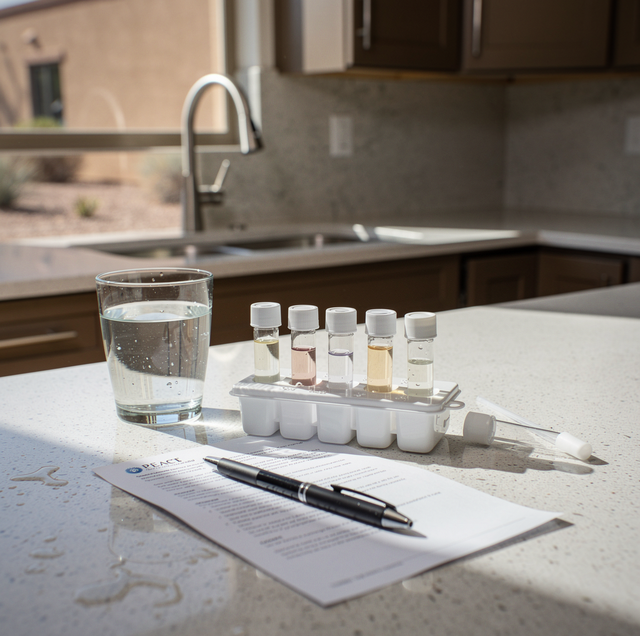
Get the numbers before you get the equipment, and get them from two places, because they answer different questions. Your utility's published water-quality report describes the treated supply as it leaves the system. A laboratory test run on a sample from your kitchen tap describes what comes out after the water has traveled through the service line and your house's piping.
Read the two together. If the constituents you care about live in the dissolved fraction, reverse osmosis is the tool aimed squarely at them, and the tank, the drain line, and the cartridge schedule come with it. If hardness dominates the results and the taste complaint tracks chlorine, then a softener and a carbon filter answer the problem directly, and a membrane adds maintenance without addressing what the test found.
Retest after anything changes the input: a new service line, a repipe, a switch in the source your utility draws from. And when a result raises a question about the people drinking the water, that question goes to the laboratory that produced the number and to the utility that publishes the report. The membrane has a defined reach. What you need it to reach is what the test tells you.
Frequently Asked Questions
Some people find it does, because the membrane removes the dissolved minerals that give water body. Systems built for that complaint add a remineralization cartridge after the storage tank, a granular bed of calcium and magnesium carbonate that the product water passes through on its way to the faucet.
Feed pressure drives water across the membrane, so a low-pressure supply results in slower production and a tank that stops filling before it is fully charged. Where line pressure is marginal, a small supplemental pump is plumbed ahead of the membrane to raise the feed side. A plumber checking static pressure at the sink can tell you whether that applies to your house before anything is installed.
The standard check is a handheld total dissolved solids meter, used to compare a sample of the incoming water against a sample from the reverse osmosis faucet. A healthy membrane produces a large gap between those two readings. When the gap narrows over successive checks, the membrane is passing more than it used to and is due for replacement, regardless of how the flow feels.
Water held in the bladder tank for long stretches picks up a flat, faintly plastic taste from sitting against the tank liner. The fix is mechanical, not chemical: draw the tank down at the faucet, let the system refill from scratch, and the taste clears.
The reject line ties into the sink drain above the trap, and where it ties in matters. Ground food waste leaves a disposal as a slurry, so a fitting set downstream of that discharge can pack shut. The tie-in belongs ahead of the disposal or on the other bowl, with the line run at a steady fall.
Many systems use an air-gap faucet, which routes the drain flow through an open break at the sink deck so drain water can never be siphoned back toward the unit. That break is what gurgles while the system produces, and it is normal. Sputtering at the spout right after a cartridge change is trapped air working its way out, and it clears after a few draws.
Find out what is actually in your water — a plumber can pull a sample, read the results against the fixtures in your house, and tell you whether a membrane or another piece of equipment addresses what the test shows. Solace Plumbing serves Gilbert and the East Valley. ROC #334000. Call (480) 630-0224.
