Choosing PEX or copper for a whole-house repipe affects how the new lines run through finished walls, the joint count the finished system carries, and how the pipe responds to water chemistry, heat, and sunlight over the years it remains in service. It does not change the fixtures at the end of the line, the main shutoff valve, or the pressure the system runs at once the job is finished. Both materials serve as whole-house supply lines, and a licensed plumber can size and install either one correctly. The choice comes down to how the specific pipe interacts with your home's layout and its water.
Lined up side by side, the two materials split on a handful of points that matter for a repipe:
| PEX | Copper | |
|---|---|---|
| Joining | Crimp, clamp, or push-to-connect fittings; no open flame | Soldered or pressed fittings; a heat source at each joint |
| Routing through walls | Flexible tubing bends around obstacles, which can cut the number of wall openings needed | Rigid pipe needs a fitting at each turn, opening more wall to route |
| Water chemistry and scale | Plastic doesn't corrode from the water side | Can develop pinhole leaks where water reacts with the metal |
| Heat and sunlight | Direct sun degrades it over time; stays indoors or shielded | Holds up under heat and sun; suits exterior or sun-exposed runs |
| Freeze behavior | Flexes as ice expansion pushes on the wall | Rigid wall can crack at the frozen point |
| Noise in the walls | Flexibility dampens some vibration | Can tick or knock as metal expands and contracts against framing |
| Repair later | A damaged section is cut out, and a coupling crimped in, no flame | A repair joint is soldered or pressed like the original run |
How Each Pipe Is Joined and Why Joint Count Matters
PEX tubing joins with crimp rings or stainless clamps that squeeze the tubing onto an insert fitting, or with push-to-connect fittings that lock onto it when pushed in; none of it calls for an open flame. Copper joins by soldering, where a plumber heats the joint and draws melted solder into the gap by capillary action, or by pressing a fitting on with a specialized tool that seats a gasket without heat. Every joint, in either material, is a place where water pressure meets a mechanical seal, and a seal can fail years after a system passes its first pressure test. A repipe run in flexible PEX can reach a fixture with a single unbroken length of tubing from a manifold or a branch line, with no joints inside the wall at all. A repipe run in rigid copper needs a fitting everywhere the pipe changes direction, so a run that turns through stud bays can carry several joints before it reaches the fixture. Fewer joints mean fewer places a seal can eventually fail, which is the practical reason joint count matters beyond the install day itself.
Soldering copper pipe indoors places an open torch flame near framing and insulation, creating a fire and burn risk inside the wall, so a licensed plumber handles the joining and confirms the main line is shut off before cutting into the existing supply pipe.
Routing a Repipe through a Finished House
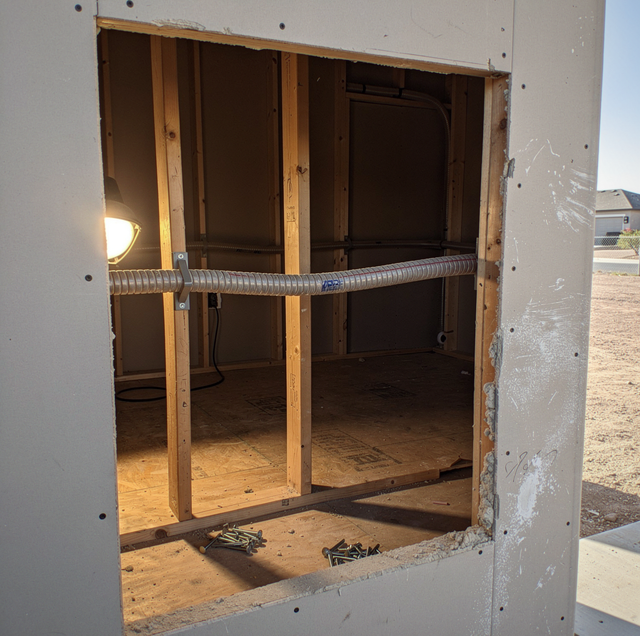
Getting new pipe from the water heater or main line out to every fixture is where the two materials part ways inside a house that is already finished and lived in. PEX tubing bends around corners, floor joists, and framing members on its own curve, so a plumber can fish a single run through a stud bay or a joist bay with one or two access openings cut in the drywall or ceiling. Copper's rigidity means a run has to be built in straight sections joined by fittings at every turn, so routing it through the same finished space calls for more access points, more cutting, and more drywall patching once the pipe is in. Both materials still need the old lines abandoned or removed, the new run tied in, and the finished system tested under pressure before the openings close; the difference is how much of the wall has to open along the way.
Water Chemistry, Pinholes and Scale
Because PEX is a plastic, it doesn't corrode from the water side the way a metal pipe can; copper can develop pinhole leaks where water reacts with the metal over time, one of the signs a plumber looks for when deciding whether a home needs a repipe in the first place. Mineral-heavy water can leave scale deposits in either material. On copper, those deposits build on a surface that is also corroding. PEX's plastic bore isn't corroding, so deposits there sit on an otherwise stable surface. Neither material is immune to what dissolves in the water; they simply respond to it in different ways over the years the system remains in service.
Heat, Sunlight and Outdoor Runs
Direct sunlight degrades PEX tubing over time, so any exposed run needs to stay indoors, inside a wall, or shielded from UV if it has to cross an outdoor space. Copper holds up under sustained heat and continuous sun exposure without that kind of breakdown, which is why it wins the call for exterior runs and sun-exposed sections, such as a line reaching an outdoor fixture. Inside a shielded wall cavity, either material handles the ambient heat of a normal house without issue; the sunlight problem only shows up where PEX is left exposed to open sky.
Freeze Behavior and Noise in the Walls
Freezing water expands and pushes outward on whatever contains it, and the two pipe materials respond to that push differently. PEX's flexibility lets the tubing give a little as ice forms inside it, which can be enough to keep the pipe intact through a cold snap that would split a rigid line. Copper's rigid wall has no give, so a hard freeze reaching an exposed or uninsulated run can crack it outright. Noise works in a related way: copper's rigid metal transmits vibration and can tick or knock as it expands and contracts against framing, or when water hammer hits a closed valve, while PEX's flexibility dampens that movement before it reaches the wall surface as sound.
Repairing a Leak after the Repipe Is Done
A future repair takes a different shape depending on which material was chosen for the run. On a PEX system, a plumber cuts out the damaged section and crimps or clamps a new coupling onto the existing tubing, with no flame and no drying-out period required. On a copper system, the repair joint is soldered or pressed the same way the original run was, which for a soldered joint means clearing any water from the line first, since a wet joint will not take solder. Either repair reopens the same kind of access point a repipe uses: a cut section of drywall or ceiling that gets patched once the new joint is tested. A sign of a slab or in-wall leak after a repipe is the same as before: close the main valve and call a plumber.
Mixing Materials in One House and Where Each Goes
A finished repipe can use both materials, each matched to the job it handles well. Copper can cover the short run into and out of the water heater and any section crossing sun-exposed or outdoor space, while PEX covers the branch lines running through the finished interior to each fixture. Where the split lands is set by how much of the house's pipe runs outdoors or in sun.
Frequently Asked Questions
No. PEX and copper meet at a transition fitting built for both materials, and a joint heated for solder cannot be made on PEX, since the heat deforms the tubing.
It can, when the PEX is run as a home-run system on a manifold with a valve for each line: each fixture gets its own line back to that central manifold, so a leak at one fixture is isolated by closing its valve while the rest of the house keeps its water.
They can when the tubing is color-coded, red for hot and blue for cold, which keeps each line identifiable at the manifold and at every fixture connection after the run disappears into the wall.
Yes. PEX expands and contracts with temperature changes, so long runs are left with a little slack and the tubing is not stapled down tight, which keeps it from binding or rubbing against framing over the years.
In the ordinary case, no. The repipe ties into the supply where it enters the house, so the meter and the point of entry stay where they are, and the pipe from that point through the house is what changes.
Crimp and clamp fittings do. Each one slides inside the tubing, so the bore through the fitting is narrower than the tubing on either side, and on a run with several fittings, those narrow points add up. That is one reason a PEX layout keeps the fittings along each run to a minimum.
Contract whole-house repiping — new PEX or copper supply lines, tie-ins at each fixture, and a pressure test on the finished system. Solace Plumbing serves Gilbert and the East Valley. ROC #334000. Call (480) 630-0224.