
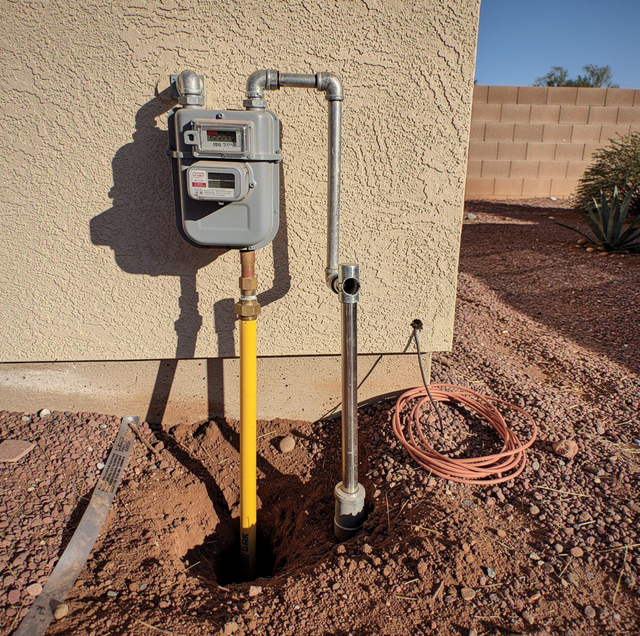
Tapping into the gas pipe you already have and running a new line from the meter can both feed a pool heater or an outdoor kitchen, and the choice between them is decided by numbers. A tee off an existing branch works when the new appliance's demand, added to everything already connected, still fits inside what the meter and that branch can deliver, and when the new burner sits close enough that the pipe doesn't lose too much pressure on the way. A dedicated line from the meter becomes the answer when either of those fails. A licensed plumber works out the load, the run, and the pipe size on-site before any pipe is bought; the gas utility rules at the meter, and the table below sets the two options side by side.
| Decision point | Tapping the existing line | Running a new line from the meter |
|---|---|---|
| Gas demand | Works only if total connected load stays within the meter and branch rating | Sized for the full new total from the start |
| Distance | Suits short runs near an existing branch | Handles long runs to the back of the lot |
| Route and trench | Shorter trench, sometimes none | Full trench from meter to appliance |
| Materials and shutoff | New shutoff at the appliance either way | New shutoff at the appliance either way |
| Test and inspection | New section tested and inspected | Whole new line tested and inspected |
| Utility side | No change if the meter has headroom | May need a larger meter from the utility |
Gas Demand Against What the Meter and Pipe Can Carry
Every gas appliance has a rating plate that lists its input in BTU per hour, and natural gas contains roughly 1,000 BTU per cubic foot. That conversion is what links an appliance to the meter, because meters are rated in cubic feet per hour. A meter rated at 250 cubic feet per hour can deliver about 250,000 BTU per hour at full capacity.
Now add up the house. A furnace, a tank water heater, a range, and a dryer each take a share of that capacity, and the plumber totals them as if they all fire at once, since on a cold evening they can. Residential gas pool heaters are sold with inputs up to about 400,000 BTU per hour, so a large heater on its own can exceed a 250-cubic-foot meter before a single indoor appliance is counted. An outdoor kitchen asks less of the system per burner, but a grill, a side burner, a pizza oven and a fire feature together add up quickly.
The existing pipe has its own limit, separate from the meter. A branch that was sized years ago for a dryer was sized for a dryer. If the plumber tees a pool heater onto it, both appliances compete for the same small pipe, and the one at the far end loses. That is one reason the answer to "can you just tap in" can turn out to be no, even on a house whose meter has room to spare.
Distance and the Pipe Size It Forces
Gas loses pressure as it travels, due to friction along the pipe wall and at every elbow and tee. Residential systems run at low pressure to begin with, so there is little room to lose. The farther the appliance is from the meter, the larger the pipe has to be to deliver enough pressure to light and maintain a steady flame.
The relationship is steep. In low-pressure gas piping, doubling a run's length reduces the capacity of a given pipe size by roughly 30 percent. A pool equipment pad at the back fence or an outdoor kitchen across a deep yard can push the line up one or two pipe sizes compared with the same appliance sitting beside the house.
This is where tapping and a new run separate. A tee near the meter on a large trunk can sometimes carry a moderate load a short distance. A long run to a high-demand appliance rules out tapping a small branch, because the pipe size the distance forces is larger than anything the existing branch offers. Some homes solve a long run with a higher-pressure delivery system, where the meter passes gas at a higher pressure, and a regulator near the appliance brings it down, which lets a smaller pipe carry more over distance. That option depends on the utility agreeing to set the meter that way, and it is the plumber's call to propose.
Gas pipe sizing, cutting, joining, and connection belong to a licensed plumber, who works from the full load total and the measured run length. Do not tee into an existing gas line or extend one yourself, even for a short grill hookup.
The Route and the Trench
Once the size is known, the line needs a path. Underground runs from the house to a pool pad or outdoor kitchen go in a trench, and the trench has to reach a depth the inspector will accept for the material being used, with warning tape laid above the pipe before backfill.
Before any digging starts, buried utilities get marked through a locate request: electric, water, irrigation, cable, and the existing gas service. A new gas trench that crosses an irrigation main or a pool's electrical conduit must be routed around them or protected where they cross.
Ground conditions change how much work the trench is. Where the soil is soft and diggable, a trench for a gas line is ordinary work, done with a walk-behind trencher or by hand. In a yard with caliche underneath, a hard layer of soil bound together by calcium carbonate, the same trench can need a rock trencher or a breaker to get through it, and that changes the schedule and how much of the yard gets disturbed. The soil you have can tip a project toward a short tap near the house, or toward a route that uses an existing open trench from pool construction.
A tapped line with a short outdoor run may need little or no trenching. A new line from the meter needs the full trench, which is why tapping looks attractive on paper even when the numbers say otherwise.
Materials and a Shutoff at the Appliance
Buried gas lines can be run in yellow polyethylene pipe, which does not rust in soil. Because plastic cannot be found with a metal detector, a copper tracer wire is laid alongside it so the line can be located later. Where the line comes up from the ground, it transitions to steel via a riser, a factory-made fitting that carries the plastic pipe within a steel casing to the surface, so no plastic is exposed above grade.
Above ground, the line is coated or painted steel, or approved flexible tubing where the plumber chooses it. At the appliance itself, the line ends in its own manual shutoff valve, a quarter-turn ball valve within reach of the appliance. A pool heater also gets a sediment trap: a short capped section of pipe below the connection that catches debris before it reaches the appliance's gas valve. An outdoor grill can be connected without one. The appliance shutoff is especially important for an outdoor kitchen, where each burner has its own valve, so one can be serviced while the others remain in use.
The materials and the shutoff are the same whether the gas comes from a tap or a new run. What changes is how much of each the job needs.
The Pressure Test and Inspection
New gas piping gets pressure-tested before it goes into service. The plumber seals the new section, pressurizes it with air, and holds it on a gauge for a set period. A gauge that holds steady shows the joints are tight; a drop that a change in pipe temperature does not explain means a leak somewhere in the new work, and it has to be found and fixed before anything moves forward.
The permit puts an inspector in front of that test. During an underground run, the inspection occurs with the trench still open, so the inspector can see the pipe, depth, tracer wire, and riser before the soil is returned. The plumber pulls the permit and schedules the inspection; keep the yard accessible and leave the trench open until it is signed off.
A tap is not exempt from any of this. The new section is still tested and inspected, and if the tee connects to an old line, the plumber may find that the existing pipe needs work before the new connection can be approved.
If you ever smell gas during this work or at any other time, that is a leak warning sign: leave the house without switching anything on or off, then call the gas utility or 911 from outside. Do not hunt for the leak or tighten a fitting yourself; the utility and the plumber find it.
The Gas Utility's Side of the Meter
The meter, the regulator, and the service line from the street belong to the gas utility. Your plumber can resize everything on the house side of the meter, but cannot change the meter itself. When the total load exceeds the meter's rating, the plumber or the homeowner submits a load request to the utility, listing the existing appliances and the new one, and the utility decides whether to install a larger meter.
That request is on the utility's schedule, and the plumber cannot expedite it. It is also the step that decides the whole question for a large pool heater. Running a perfectly sized new line from the meter does nothing if the meter cannot pass the gas, so the utility's answer comes first, before the trench is dug and before the pavers go down.
Gas demand and the utility's meter decide whether the house can supply the appliance at all. Distance and pipe size decide whether a tap can carry it. The route, the materials and the inspection follow from those answers: the same steps either way, with a longer trench and more pipe on a new run.
A pool heater or an outdoor kitchen is the easy choice. The gas behind it is settled by arithmetic: the load, the meter, the distance and the pipe size, worked out before the first shovel goes in, so the trench only gets dug once.
Frequently Asked Questions
It can, and a portable tank avoids trenching entirely. A grill built for natural gas cannot simply be connected to propane, though: it needs a conversion kit with different burner orifices and a different regulator, which must be fitted by a qualified technician. Propane carries roughly 2,500 BTU per cubic foot, so the orifices are smaller.
Corrugated stainless steel tubing is approved for some outdoor and above-grade runs when it is type-rated for that use. It must be bonded to the home's electrical grounding system, a connection that reduces damage if lightning strikes nearby. A run of this tubing without that bond is a defect.
The rating plate lists a minimum inlet gas pressure. When the line or meter cannot meet it, the heater may fail to light or lock out due to an ignition fault, and the pattern may appear only when the furnace or water heater fires at the same time. A plumber confirms it by reading the pressure at the heater's inlet while everything runs.
Yes, plan it before the hardscape. If the line cannot be run yet, have a sleeve, a length of larger pipe, laid under the future patio or deck before it is poured. The gas line can be pulled through it later without cutting concrete or lifting pavers.
The gas is shut off at the meter while the new line is being tied in, so every gas appliance in the house goes out during that window. Afterward, each one has to be relit and checked, including pilot lights on older water heaters and furnaces as well as the new appliance.
Yes, if the plan accounts for it now. The plumber can size the new line for the appliances you expect to add and leave a capped, valved outlet at the outdoor kitchen or pool pad, so that a later fire pit can connect there without a second trench back to the meter.
Book a gas line load check for your pool heater or outdoor kitchen — find out whether your meter and existing pipe can carry the new appliance, and what size a new run would need. Solace Plumbing serves Gilbert and the East Valley. ROC #334000. Call (480) 630-0224.