Water Heater Repair or Replace: What the Signs Mean
The shower runs cold halfway through, or you walk past the water heater and hear a sound like popcorn popping inside the tank. Neither one tells you what to do next. A water heater rarely fails all at once; it usually sends signals for weeks or months first, and the trick is knowing which signals mean "fix the part" and which ones mean "the tank itself is done."
The difference comes down to where the problem is happening and what's actually wearing out. A failing part bolted to the outside of the tank, a thermostat, a heating element, a gas valve, is a repair. A problem with the tank's inner lining or shell is not, because once that layer breaks down, there's no fixing the vessel that holds the water.
What's Actually Wearing Out Inside the Tank
Every standard tank water heater has a steel shell lined with glass (technically a vitreous enamel coating) to keep the metal from touching water directly. A sacrificial anode rod, usually magnesium or aluminum, hangs inside the tank and corrodes on purpose. As long as the anode has metal left to give up, it takes the corrosion instead of the tank. Once the rod is consumed down to its steel core wire, the tank's steel shell becomes the next thing exposed to corrosion, and that process can't be reversed with a repair.
Hard water speeds up a second wearing mechanism: sediment. Dissolved calcium and magnesium drop out of solution as the water heats and settle at the bottom of the tank. In an area with unusually mineral-heavy water, that layer builds faster than it would with softened or naturally soft water. Once sediment covers the burner or lower heating element, it insulates that surface from the water above it, so trapped water underneath the sediment boils and pushes steam bubbles up through the crust. That's the popping or rumbling sound, sometimes called kettling. It also means the heater works harder and longer to reach the same temperature, since the sediment layer is acting like a blanket between the heat source and the water.
Tankless units skip the storage tank and its sediment layer, but they have their own wear point: a compact heat exchanger with narrow internal passages. The same minerals that settle in a tank instead build a scale coating on those passages, which restricts flow and shows up as an error code or a slow drop in hot water output rather than a rumbling sound.
Reading the Repair Signs
A handful of common problems are legitimate repairs regardless of the unit's age because they involve parts, not the tank body itself.
A dripping temperature-and-pressure relief valve. This valve is a true safety device: it opens automatically if the tank's internal pressure or temperature climbs too high, protecting against a dangerous buildup. A slow drip can mean that sediment or mineral scale is preventing the valve seat from sealing fully, or that the valve itself has reached the end of its service life. Either way, it's a valve swap, not a tank replacement, unless the drip is actually water tracking down from a leak higher up.
A failed heating element or thermostat (electric units): Electric tank heaters use one or two resistance elements to heat the water; either can burn out due to age or from sitting under a thick sediment layer that traps heat against the element. Swapping an element is routine.
A pilot or ignitor problem (gas units): A gas water heater that won't light, or won't stay lit, often traces back to a dirty flame sensor, a worn thermocouple, or a clogged pilot orifice, all serviceable parts.
Popping and rumbling with an otherwise healthy tank: If the unit is a few years old and has no visible rust or leaks, a flush to clear sediment often quiets the noise and restores efficiency.
Reading the Replace Signs
Certain signs point to the tank itself, not a bolt-on part, and no amount of repair changes that.
Rust-colored hot water from every hot tap in the house, especially when the cold water runs clear, usually means the tank's interior lining has broken down and the steel shell is corroding into the water supply.
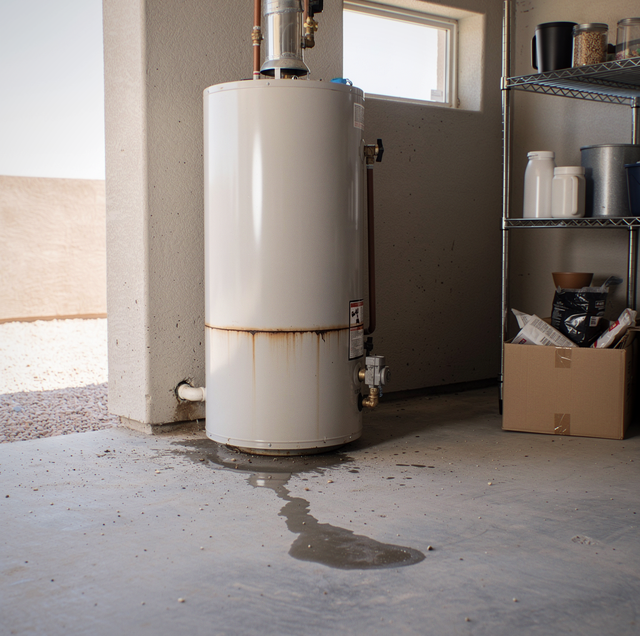
Moisture or rust weeping from a seam, the bottom, or the tank body itself (not from a fitting, valve, or the T&P discharge pipe) means the tank has developed a breach in its shell. There's no patch for a leaking tank; once the steel is compromised, replacement is the only real path.
Age beyond the 8-to-12-year range for a standard tank, especially when combined with any of the above. Every tank eventually reaches the point where the anode rod is spent, and internal corrosion has begun, even without a visible leak yet.
A cracked or failed heat exchanger on a tankless unit: This is the core, sealed component; unlike scale buildup, a crack is not something a service call resolves.
| Factor | Points Toward Repair | Points Toward Replacement |
|---|---|---|
| Age | Under 6-8 years | Past 8-12 years (tank) or major heat-exchanger failure (tankless) |
| Leak location | Fitting, valve, T&P discharge pipe, drain valve | Tank seam, tank body, or bottom of the shell |
| Water color | Clear, occasional cloudiness that clears | Persistent rust or brown tint from hot taps only |
| Noise | Popping/rumbling with no visible rust | Loud noise plus a confirmed leak or heavy corrosion |
| Component | Thermostat, element, thermocouple, ignitor | Tank shell, glass lining, tankless heat exchanger |
Stretching the Life You Have Left
A few habits slow down the wear mechanisms described above, regardless of which side of the repair-or-replace line a unit currently sits on. Draining a few gallons from the tank's bottom drain valve every few months flushes loose sediment before it packs down into the hard crust that causes rumbling and insulates the burner. Where the water is especially mineral-heavy, an annual flush does more work than the same routine would in a naturally soft-water area, since sediment accumulates faster.
Checking the anode rod on the schedule below catches a spent rod before the tank's steel shell becomes the next thing to corrode. On a tankless unit, running a manufacturer-recommended descaling solution through the heat exchanger at set intervals prevents mineral scale from narrowing the internal passages enough to trigger error codes or reduce flow. None of this prevents a unit from eventually reaching the end of its service life, but it does keep a mid-life unit from being pushed into premature replacement by neglect rather than genuine age.
What Tips the Decision When It's Not Obvious
Sometimes a unit sits in the gray area: no leak yet, but old and starting to make noise. In that case, weigh how much of the unit's expected life has already been used against how much remains. A unit at year 5 with a bad thermostat is worth fixing. A unit at year 11 with the same failure is closer to the point where a second or third repair becomes likely within a year or two, since the surrounding parts are aging at the same rate.
It's also worth having a plumber pressure-test and visually inspect the tank rather than guessing from the outside. A tank that looks fine from the front can already be rusting from a seam tucked against the wall, and a technician who works on these units regularly can spot early corrosion, a swollen or bulging shell, or a compromised anode before it turns into a flooded utility closet.
Frequently Asked Questions
A standard tank typically lasts 8 to 12 years, though unusually hard water can shorten that if the anode isn't checked. The rod is meant to be pulled and inspected roughly every 2 to 3 years; if it's worn down to a thin wire core with little metal left, or coated in a thick calcium crust, it's no longer protecting the tank and should be replaced before the shell starts corroding.
Usually yes. The valve threads into the tank and can be swapped on its own in most cases. The one exception is when the leak is due to excess tank pressure caused by a failed thermal expansion tank or a stuck check valve on the water line, since in that case the T&P valve is doing its job correctly and the real fix is elsewhere in the plumbing system.
Not necessarily. Condensation can form on a cold water line during warmer months, or briefly while a tank refills after a big draw, and that moisture can collect at the base without meaning the shell has failed. What tips it toward an actual leak is a puddle that returns after being wiped dry, with nothing running nearby, or one that appears alongside rust-tinted water or a seam that feels damp to the touch. At that point it's worth having a plumber confirm the source rather than guessing either way.
It can be worth discussing with a plumber, since a heat pump water heater moves heat from the surrounding air into the water rather than generating heat directly, which uses meaningfully less energy per gallon heated. The trade-off is that it needs a location with enough surrounding air volume and produces a cool exhaust, so it isn't a fit for every closet or utility space.
A weeping seam typically gets worse, not better, because the corrosion that created it continues. Waiting risks a sudden split rather than a slow drip, which can release the tank's full volume, 40 to 50 gallons for most residential units, onto the floor in a short window instead of the trickle you can currently see.
It does, though the difference is more about the water than the rod itself. Magnesium corrodes faster and protects more aggressively, which suits most tanks and most water chemistries. Aluminum lasts longer but can leave a gray residue in the water, so some households switch to it specifically because their water reacts with a magnesium rod, producing a sulfur odor that aluminum doesn't cause.
A water heater's warning signs are really a set of parts and materials, each wearing out at its own pace, and reading them correctly is mostly a matter of knowing where the corrosion or scale is actually located. When you can't tell from the outside whether it's a five-minute part swap or the tank itself giving out, a hands-on inspection settles it before you're stuck without hot water on a random Tuesday.
Schedule a water heater inspection — get a straight answer on repair versus replacement before the tank fails on its own schedule. Solace Plumbing serves Gilbert and the East Valley. ROC #334000. Call (480) 630-0224.
