
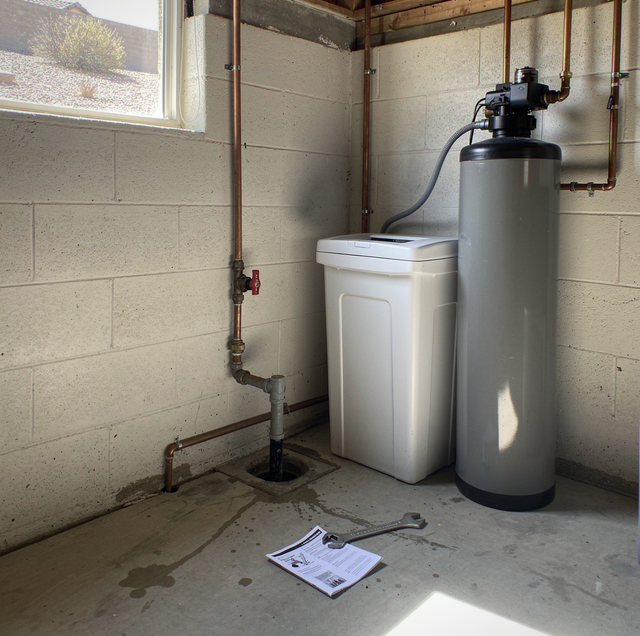
Water softener and water conditioner are used interchangeably in everyday conversation, but they refer to two different pieces of equipment that solve the hardness problem in opposite ways. A softener runs incoming water through a bed of resin that trades calcium and magnesium ions for sodium or potassium ions. Hence, the minerals that cause scale leave the water entirely. A conditioner works on the same minerals without removing them: it changes their physical structure so they are less likely to bond to surfaces, while the calcium and magnesium remain dissolved in the water that reaches your tap. Choosing between them comes down to which outcome matters most for your fixtures, your water heater, and how the water feels when it leaves the faucet.
A softener and a conditioner differ in what happens to the minerals, what the install asks of the house, and how the water feels once it reaches the tap.
| Water Softener | Water Conditioner | |
|---|---|---|
| How it works | Ion exchange swaps calcium and magnesium for sodium or potassium at a resin bed | A media bed converts dissolved minerals into microscopic crystals rather than removing them |
| What's in the water afterward | Hardness minerals are gone, replaced by a small amount of sodium or potassium | The same minerals remain dissolved, just restructured |
| Salt and regeneration | Needs a stored supply of salt or potassium chloride and runs a periodic regeneration cycle | Uses no salt and runs no regeneration cycle |
| Drain connection | Regeneration discharges backwash water, so a drain line is needed at the install point | No backwash, so no drain connection is required |
| What the water feels like | Minerals are gone, so water can feel slicker on skin and lathers soap with less product | Minerals stay in the water, so the feel at the tap is close to what came in |
| Upkeep | Salt supply gets restocked, and the resin bed is serviced over its working life | Upkeep is limited to swapping the media cartridge on its own schedule |
How Ion Exchange Softening Works
A softener's resin bed is made of small polymer beads, each holding a stored charge of sodium or potassium ions on its surface. As hard water moves through the bed, calcium and magnesium ions trade places with the ions already on the beads: the resin holds onto the hardness minerals and releases sodium or potassium into the water in their place. That exchange continues until the resin bed's capacity is used up, at which point the system flushes the bed with a concentrated brine solution drawn from the salt or potassium chloride stored in its tank. The brine strips the collected calcium and magnesium off the resin and carries them to the drain, and the freshly recharged beads go back to work. This regeneration step is what gives a softener its ongoing need for a stored salt supply and a drain connection at the point of installation.
How Salt-Free Conditioning Works
A conditioner works on the same calcium and magnesium without an exchange step. Water passes through a media bed designed to provide mineral ions with a surface to cluster on. Template-assisted crystallization is one method used for this: the medium provides nucleation sites where dissolved calcium and magnesium form microscopic crystals rather than remaining as free ions in solution. Those crystals are small enough to remain suspended in the water and pass through the plumbing rather than settle on a hot surface or fixture. Nothing is added to the water, and nothing is removed from it; the minerals are still there, restructured into a form designed to resist sticking. Because there is no resin bed to recharge, a conditioner has no regeneration cycle, no brine tank, and no drain connection at the install point.
Hardness is measured in grains per gallon (gpg). A home test strip gives a rough reading; a lab test or a titration kit reading gives the number a softener or conditioner is chosen against.
What Each Does About Scale on Heaters, Fixtures and Glass
Scale forms when calcium and magnesium come out of solution and bond to a hot or hard surface: inside a water heater tank, on a showerhead, across a glass shower door. A softener prevents that buildup by removing minerals from the water before they reach those surfaces, so there's nothing left to bond. A conditioner leaves the minerals in the water but changes their crystal structure so they resist adhering; the crystallized particles are built to pass through rather than plate onto a surface, though the untreated minerals are still present in every gallon that leaves the tap.
A softener or conditioner ties into your home's main water line under full house pressure, and in some houses that pipe also carries part of the electrical grounding path. Leave the cut-in, bypass valve, and jumper wire to a licensed installer.
What Each Asks of the House
A two-tank softener needs a few things nearby to run: a drain within reach of the discharge line for the regeneration cycle, floor space for a resin tank and a brine tank holding the stored salt or potassium chloride, and, for an electric control valve, a nearby outlet for its timer or metering circuit. The salt supply gets checked and topped off on an ongoing basis, and the brine tank needs enough headroom for a bag to be poured in. Whichever unit goes in, its bypass valve stays within easy reach, so water can be routed around the unit while the control head is serviced or the media is changed, and the house keeps running water in the meantime.
A conditioner asks for less. Because a media conditioner never regenerates, it needs no drain connection and no brine tank, and no outlet unless it is an electronic unit, so it can go in tighter spaces, including places where running a drain line would be difficult, a garage wall, a utility closet, or a crawlspace along the main line. With a conditioner, the minerals stay in the water; what the choice changes is how much equipment and upkeep it adds to the house.
Matching the System to the Household
The decision turns on questions only you can answer for your own household: whether mineral-free water at every fixture matters to you, for laundry, for skin, for how soap and shampoo perform; whether you are willing to manage a salt supply and a drain connection for a regeneration cycle; and whether keeping the minerals in the water, just restructured, meets what you want from your plumbing and your water heater. A water test settles the one variable that changes the stakes of that decision: how much hardness your supply carries, and that number, not a guess, is what tells you whether either option is solving a real problem or answering one that does not exist at your address.
The two options are not mutually exclusive with the rest of a home's water treatment plan. A household can run a softener or conditioner for the whole house and still add a separate, smaller unit at the tap for drinking water, since the point-of-entry equipment and a drinking-water system address different questions about what is in the water.
Frequently Asked Questions
Not reliably. Iron and manganese coat a crystallization media bed and block the sites where the crystals form, so water carrying either one is treated for it ahead of the conditioner. A softener's resin tolerates small amounts of both, and a water test that reads hardness can report iron and manganese in the same sample, which settles the question of whether that extra step belongs in the install.
No. A softener is sized based on the home's measured hardness and daily water use, which determines how much resin needs to run between regenerations. A media conditioner is sized instead based on the home's peak flow rate and line size, with the hardness reading only confirming that it falls within the media's working range.
There's no drop in flow or pressure to warn you: spent crystallization media doesn't restrict water the way a clogged resin bed can, so the tap runs the same whether the media is fresh or spent. Replacement follows the media's rated service life, and scale reappearing on fixtures and glass is a sign that the media is past its service life.
No. It regenerates either on a preset schedule or measured against the gallons that pass through it, and sits idle letting water flow through the resin bed the rest of the time. A metered valve triggers regeneration by usage rather than by the calendar, so the number of regeneration cycles in a month tracks the gallons passing through the meter, not a fixed date.
Neither unit is built to remove it. Both govern what the water carries from the point of installation forward; a deposit already bonded to a heating element or a pipe wall comes off through a descaling flush or by replacing the part.
No. A sediment or carbon filter removes particles or chlorine and taste compounds by straining or adsorption, and does nothing to how calcium and magnesium behave in the water. A filter and a conditioner solve separate problems and can be installed on the same line.
Reserve water softener or conditioner installation — each system is sized to what a water test shows for your house. Solace Plumbing serves Gilbert and the East Valley. ROC #334000. Call (480) 630-0224.