
Grease Trap Backing Up in a Restaurant? What Puts a Kitchen Down
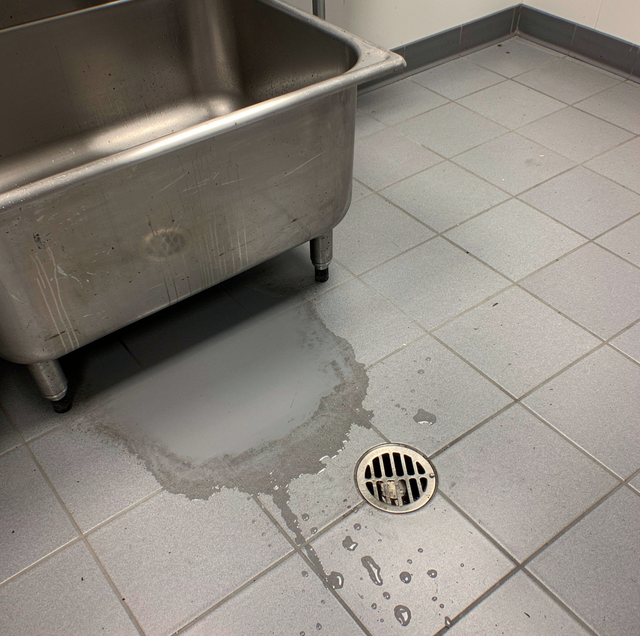
A grease trap can be doing exactly the job it was built to do and still be the reason the floor drain is coming up. The dish pit is holding water it should have swallowed twenty minutes ago, the mop basin beside it is gurgling, and a grey film has reached the tile around the drain in mid-service.
Two different failures produce that scene, and each calls for a different response. One is a trap that has filled: it still passes wastewater, but the grease it should hold is going down the line behind it. The other has stopped passing wastewater at all, and something physical is sitting in the flow path. What you do in the next hour depends on which one you have.
A Full Trap and a Blocked Trap Fail Differently
A grease trap works on time and buoyancy and nothing else. The plumbing code defines a gravity grease interceptor as a plumbing appurtenance identified by volume, installed to intercept nonpetroleum fats, oils, and grease from a wastewater discharge using gravity only. Wastewater arrives warm and turbulent; the tank slows it, and the globules rise while the water underneath moves on toward the outlet.
A full trap is still doing that, badly. The floating cap has grown, the settled layer beneath it has grown, and water passing between them spends less time in the tank. Flow continues. Your dish pit still drains. The change is that grease the tank should hold rides out the outlet and cools in the pipe beyond it, and you will not see the result for weeks.
A blocked trap is a different event. Wastewater has stopped moving through it, so the level rises until it finds the lowest opening on the branch it serves, which in your kitchen is a floor drain. Nothing about it is gradual, and nothing about it waits for your service to end. The tank can be nowhere near full when it happens, because a blockage closes a path rather than filling a volume. Everything discharging to the trap has to stop because each gallon that comes in comes back out at the floor drain.
The Two Ends Where the Flow Path Closes
A trap has two connections, both narrower than the tank between them. The inlet arrangement breaks the incoming velocity so water from your dish pit calms instead of driving straight across. The outlet draws from below the floating layer.
Those same two points close first. The floating cap chills against the walls and the air above it, stiffens, and grows down around the inlet baffle and outlet tee until it bridges the fitting. Once that bridge reaches the outlet invert, your tank is a sealed box still taking water.
The bottom closes the same way from the other direction. Food debris and coffee grounds are denser than water, settle out, and build up under the outlet where your tank is deepest. A solids layer tall enough to reach the outlet's draw does what the cap does, from below.
The two ends look different from outside. A closed outlet holds the tank level high and backs the branch up behind it; a closed inlet holds water in your fixtures and leaves the tank looking normal when the lid comes off. An in-ground interceptor is a confined space holding decomposing organic matter, so that lid comes off for a crew equipped for it.
The Clear Zone Between the Cap and the Solids
Separation is time-dependent, so your tank's working part is the quiet water between the floating cap and the settled solids. Stokes' law gives a globule's rise velocity from its diameter, its density, and the viscosity of the surrounding water, and the numbers are small. Industry guidance on grease interceptor sizing works in one case: a 200-micron globule at 54 pounds per cubic foot, in water at 50 degrees, rises about 0.007 feet per second. Halve the diameter to 100 microns, and the rise drops to about 0.002 feet per second, since velocity follows the square of diameter. A globule that slow needs your tank's whole depth and dwell time to reach the surface.
Both layers grow inward in that zone. The cap grows down, the solids grow up, and the flow that once spread across the full depth now moves through a thinner band, which means it moves faster. Research on grease interceptor design has found more effective separation when fluid velocities near the inlet and outlet were held below 0.6 inches per second. Retention time falls well before the tank is full, and the trap that held grease last month starts passing it into your line at the same flow.
A technician measures the floating cap and settled solids against liquid depth at the access port. At a quarter of that depth, the clear zone closes. Some sewer authorities set their threshold there; whether yours does is your sewer authority's question.
What Detergent and Hot Water Do to a Grease Globule
Detergent and discharge temperature arrive at the inlet and defeat a tank that is correctly sized and freshly pumped. Kitchen detergents and degreasers contain emulsifiers, which reduce the interfacial tension that causes grease globules to attract one another. Lowering that tension is what makes the plate come clean. It also keeps globules from merging in the tank, and one that stays small rises too slowly to clear the depth in time.
Temperature does the second half. At higher temperatures, water tends to prevent FOG from coalescing, so hot discharge from a dish machine delivers smaller globules than warm rinse water. A large tank pulls some heat back out because the water mass and walls act as a heat sink, allowing cooler, merged globules to form. A tank near its flow limit does not get that time.
Neither shows up as a fault at the trap. Your tank looks right when it is opened, the layers read low, and the restriction is past the outlet, where fine, still-dispersed grease has cooled against pipe wall for months. If your trap keeps coming back clean while your line backs up, the dish machine's discharge temperature and the pot sink degreaser are the inputs worth changing.
The Lateral That Was Glazed Months Earlier
A trap that spent a year passing grease has already put the restriction somewhere else. What escaped the outlet is in your building lateral, coating the crown and the sides of the pipe, and it got there over months while a trap that still drained gave you nothing to see. A pump-out in this case looks useless. The tank comes out clean, your kitchen runs two services, and the floor drain surfaces again on the next busy night, because nothing that was done touched the restriction.
Separating the two runs in a fixed order, and the order is the point. The tank is pumped, and then a camera goes in below the outlet, because a full tank gives the camera nowhere to enter and nothing to see. If the lateral comes back glazed, jetting that line is the work, and the pump-out was the access to it. If the lateral comes back open, the restriction is at the trap's own fittings, and it will be back within the interval it took to build. Either result comes out of one visit instead of two closures.
The Flow Control Fitting and Its Air Intake
When your correctly sized hydromechanical unit keeps failing, a technician goes looking for the flow control fitting first. It is a small device on the inlet side, upstream of the interceptor, within reach of later work.
The fitting has an orifice that limits how quickly wastewater enters. A hydromechanical interceptor separates continuously, at the velocity at which water enters it, so the rate reaching the inlet is the condition its performance rests on.
The vent on that fitting is an air intake. It admits air behind the discharge so the pipe cannot siphon and holds the orifice steady rather than surging when a filled sink is released.
The fitting gets left off at the rough-in, and nobody notices until the unit has failed long enough to be blamed. Or someone caps it later, reading an open vent over your sink as a leak.
Either way, the flow reaching the unit is no longer what it was rated at, and the FOG it catches can plug the orifice. The interceptor performance standard certifies a hydromechanical interceptor as installed with an external, vented flow control, which is the product standard's test condition rather than a statement about your building. The unit is the right size on paper and is separating at a velocity nobody tested.
Frequently Asked Questions
Watch your floor drain and the clock. A floor drain is the lowest opening on the branch, so it surfaces in both cases, but the two recover differently. A trap that is only full lets the level fall back on its own once the rush at your dish pit ends. A blocked one holds the level where it is, and your fixtures stay standing long after the last rack has gone through.
They move it rather than remove it. Those products emulsify FOG so it leaves the tank as fine droplets, and the material then redeposits farther down the lateral, where nothing is waiting to catch it. Published operation and maintenance guidance for grease interceptors directs owners not to use additives such as enzymes or grease solvents. Pumping takes the material off your site; an additive relocates it.
Because it stops being fat. Research on sewer deposits has found that FOG deposits in sewers are essentially metallic soaps. The reaction starts at the point of discharge, where FOG from dishware at your pot sink meets excess cleaners and sanitizers, so the deposit reaching the lateral is harder than the grease that left the fryer.
Not on its own. Gravity interceptors were once sized for flow plus expected retained solids, which made them larger, and published sizing guidance reports that field experience has since shown oversizing can generate hydrogen sulfide and sulfuric acid, destroying the interceptor and the drainage system around it. A tank matched to your kitchen's peak flow holds water long enough to separate and no longer.
When fixtures in your building that never route through the interceptor start backing up too. Grease-bearing fixtures are piped to your trap; restrooms and hand sinks, on a separate branch, bypass it entirely. If your restroom floor drain surfaces at the same time as the kitchen's, the restriction is downstream of where the trap's outlet rejoins the building drain, which puts the work on the main line rather than the trap.
It depends which family you have. A hydromechanical interceptor is sized in gallons per minute and performance-tested at exactly that rated flow under the interceptor performance standard, so a 20 gpm unit was tested with 20 gpm of grease-laden water. A gravity interceptor is identified by its volume in gallons and conventionally sized by multiplying peak flow by a 30-minute detention time, yielding roughly 600 gallons for that same 20 gpm kitchen.
A kitchen that has stopped taking orders needs the trap pumped before the line below it is scoped — the camera cannot see a glazed lateral until the tank is empty, so a round-the-clock crew can run the sequence in one visit instead of across two closures. Solace Plumbing serves Gilbert and the East Valley. ROC #334000. Call (480) 630-0224.
