
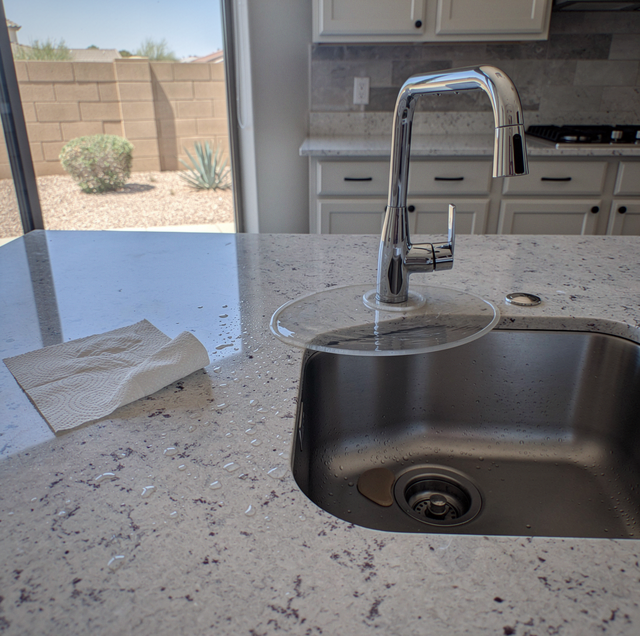
A faucet that starts leaking within weeks of installation indicates a fault in its parts or installation, since every seal is still new. Water at the base can come from several different points that all look identical from above the counter: the O-ring where the spout swivels, the gasket or deck plate under the whole faucet body, the nut holding the faucet to the sink, a supply-line fitting down in the cabinet, or a cartridge sending water up and out around the handle rather than the spout. A new faucet leaking this soon points to a defective seal, a part that was not seated correctly, or a connection that was not tightened enough. Matching where the water shows up to the part behind it is how to narrow it down.
Is the Water Coming From the Spout or the Deck?
The first split is simple: does water appear where the spout meets its base and rotates, or does it pool under the entire faucet body on the counter or sink deck? A spout-only leak indicates the O-ring is sealing the swivel joint. A leak that shows up under the whole fixture, spreading out from underneath rather than dripping from one point, points first to the base gasket or deck plate seal, or to a cartridge whose leak runs down the body to the base. A faucet that shifts or rocks when pushed sideways adds a third signal: a mounting nut that is not snug. Matched against each other, those signals line up like this:
| Where the water shows | What it points to |
|---|---|
| Beads or drips where the spout swivels | Spout O-ring |
| Pools under the whole faucet body | Base gasket or deck plate seal |
| Faucet rocks or shifts at the deck | Loose mounting nut |
| Water at a fitting under the sink, not at the faucet | Supply-line connection |
| Water seeps up around the handle, not the spout | Cartridge, not the base |
| Leak starts right after a fresh install | Seal or sealant issue from installation |
Why Do Spout O-Rings Leak So Soon After Installation?
A swivel spout, the kind that turns side to side over the sink, seals against its base with one or more rubber O-rings instead of a solid connection. On a brand-new faucet, an O-ring can leak on first use for reasons unrelated to wear: a ring nicked during assembly, one that never seated fully in its groove, or a spout forced onto its base before the O-ring settled into place. A thin coat of silicone-based plumbing grease on the O-ring at installation lets the spout turn into position without rolling or pinching the ring, and skipping that step is one reason a new spout weeps at the swivel from its first turns. Turning the spout fully in both directions and watching for a bead of water right at the swivel, rather than lower down on the body, confirms the O-ring as the source before anything gets pulled apart.
Photograph the model number on the faucet's box or on the tag on its supply hose before the plumber arrives. Spout O-rings and deck gaskets are sized to each model, and the number lets the right parts be matched.
Could the Base Gasket or Deck Plate Be the Source?
Underneath the visible faucet body sits a gasket, and on some faucets a separate deck plate, that seals the connection between the fixture and the counter or sink deck. If that gasket is flattened, warped, or simply missing a factory step, water works its way out from under the entire base rather than from a specific point, and can appear as a thin ring of moisture that traces the outline of the faucet's footprint on the counter. This kind of leak is sometimes blamed on the faucet needing to be replaced, but reseating the existing gasket or dropping in the one that should have shipped with the unit can solve it without a new fixture.
Is the Faucet Loose at the Deck Mounting Nut?
A faucet that shifts side to side or rocks slightly when pushed is not seated tightly against the deck, and that movement stresses the gasket beneath it, turning a snug seal into a slow leak over time. The mounting nut underneath the sink, reached with a basin wrench, threads onto the faucet's shank, pulling the fixture down against the deck gasket. If it backed off during shipping or was left short during installation, a plumber snugging it evenly draws the gasket back into full contact, which can stop the leak without further work.
A cracked faucet shank or a split supply line under pressure can fail at once and flood the cabinet. Close both shutoff valves before touching any nut, line, or fitting under the sink, and leave tightening the mounting nut to a plumber.
Is the Leak Coming From the Supply Lines Under the Sink?
Water pooling at the bottom of the cabinet or on the shutoff valves below is a different problem, even though it can travel and appear to come from around the faucet. The supply lines connecting the shutoff valves to the faucet's tailpieces are two spots that can go untightened during a new install, and a compression fitting that is slightly cross-threaded weeps steadily rather than drips. A braided supply line has its own washer seated inside the connector nut, and that washer can be missing, folded over, or cut during the swap if the old line was reused rather than replaced with the faucet. Drying the cabinet floor completely, then running the faucet and watching the connections directly, separates a supply-line leak from a true base leak and shows whether any of the leak is below the deck before any part of the faucet gets removed.
Does a Cartridge Problem Show Up Around the Handle?
A cartridge that is not sealing inside the valve body can push water up and out around the handle, where it runs down the faucet body and collects at the base. So a puddle at the base, with a wet handle above it, points past the base gasket to the cartridge.
Did an Installation Error Cause This?
Several installation mistakes can produce a leak on a faucet only a few weeks old. Overtightening the mounting nut can crush the deck gasket, working against the very seal it is meant to protect. Skipping the gasket entirely, or leaving the factory's protective film stuck to it, blocks the seal from making contact at all. On a natural stone or heavily textured deck, the wrong sealant, or none at all, under the deck plate leaves gaps the stone's texture will not close by itself, and water finds them from the first use. Reusing an old supply line with a new faucet can pair a nut and a tailpiece that do not match, and a nut forced onto the wrong thread cross-threads and weeps, however hard it is turned. Each of these leaks shows up on day one, which first points to redoing part of the installation, with a defective part replaced where the fault lies in the part itself.
Frequently Asked Questions
A deck gasket can arrive creased or pinched in its packaging, and a gasket that is already out of shape will not seal evenly, however carefully the faucet was tightened down. A replacement gasket, or a reseat by the plumber, fixes it without a new faucet.
Yes. A swivel spout can seal against two stacked O-rings, one above the other, so replacing the top ring and still seeing a seep can mean the lower ring, seated deeper in the spout housing, is also worn or missing.
No. On a faucet with extra pre-drilled holes in the sink, the plate covering them, called an escutcheon, has its own separate gasket underneath it. A leak from under the escutcheon looks identical to a base leak but requires its own gasket to be replaced, not the faucet's main seal.
Only until the faucet stops moving on the deck. A plumber draws the nut up evenly and stops there, since cranking it down as hard as a wrench allows can bow the faucet's base and break its seal against the deck. If the nut needs several extra turns to stop the movement, the gasket under the base may already be worn or seated wrong.
That points to the diverter valve inside the faucet body rather than the base gasket. The diverter redirects flow from the spout to the side sprayer's hose, and a diverter that does not seal fully lets pressurized water escape at the base only while the sprayer is active, not during normal spout use.
Dry the entire deck around the faucet and the cabinet floor beneath it completely, then run the faucet while watching both areas. Water reappearing at the swivel first points to the spout O-ring, water spreading from under the whole base points to the gasket or a cartridge leaking down the body, and water only under the sink points to a supply-line fitting instead.
Put a faucet base-leak repair on the calendar — a plumber pins down the O-ring, gasket, nut or supply fitting at fault and fixes it without replacing a sound faucet. Solace Plumbing serves Gilbert and the East Valley. ROC #334000. Call (480) 630-0224.