Why Is One Sink Draining Slowly? 4 Likely Culprits
Quick Answer: If only one sink in your house drains slowly and every other fixture works fine, the problem is almost always local to that one sink, not your main sewer line. The blockage is usually sitting in the P-trap under the basin, in the pop-up stopper assembly, or in the short branch pipe that carries that sink's water to the larger drain. A bathroom sink most often slows from hair and soap gripping the pop-up rod; a kitchen sink slows from cooled grease and food. Clearing the trap and stopper by hand fixes most cases. When several fixtures slow at once, the trouble has moved deeper into the shared line.
A single slow drain is one of the more useful symptoms a plumbing system can give you, because the pattern itself tells you where to look. When one sink gurgles and pools while the tub, the other bathroom sink, and the kitchen all empty normally, the water is telling you something specific: the restriction lives close to that one basin. Reading that clue correctly saves you from tearing into the wrong part of the system.
One Slow Sink vs the Whole House
Drains in a home branch outward like tree limbs. Each fixture has its own small pipe, called a branch line, that runs a few feet before joining a larger shared drain, which eventually meets the main line out to the sewer or septic tank. Water from every fixture funnels through that shared path on its way out.
That layout is why the pattern matters so much. If a clog sat in the main line, it would back up everything upstream of it, so you would see several fixtures slowing together, often the lowest ones first, like a tub or a floor drain. A main-line problem cannot cause one lonely slow sink, because a main-line blockage does not politely spare the fixtures next to it. So when the slowness is isolated to a single basin, the restriction has to be in that sink's own hardware or its short branch pipe, upstream of where it joins anything shared.
Confirming this takes two minutes. Run the tub, the other sinks, and flush a toilet, and watch whether anything else drains slowly or gurgles. If they all run clear and fast, you have a local clog and can work on that one sink with confidence. If a second or third fixture is sluggish too, stop cleaning traps and treat it as a deeper shared-line issue, which is a different job.
The Usual Suspects Under a Bathroom Sink
For a bathroom basin, two parts cause the overwhelming majority of slow drains, and both sit within arm's reach under the counter.
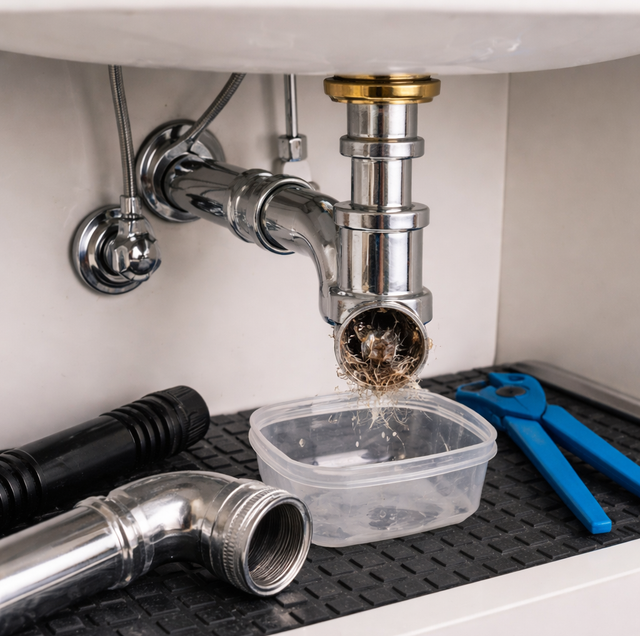
The P-Trap: The P-trap is the U-shaped bend of pipe directly below the drain. It holds a small pool of standing water on purpose, which seals out sewer gas. That same curve is where debris settles, because water slows and swirls at the bottom of the bend. Hair, soap scum, toothpaste, and a slick coating of biofilm collect there over months and gradually narrow the opening until water backs up.
The Pop-Up Stopper: The metal or plastic plug you lift with the lever behind the faucet is the pop-up stopper, and in a bathroom sink it is the single most common trap for hair. The stopper's stem hangs down into the drain, and strands wrap around it and knit together with soap into a dense mat. People often overlook it because the stopper looks clean from above while a wad the size of a golf ball hangs below the surface. Pull the stopper out and the cause is usually obvious at a glance.
Why a Kitchen Sink Clogs Differently
A kitchen drain slows for its own reasons, and grease is the ringleader. Fats and oils go down warm and liquid, then cool and stiffen against the pipe wall a foot or two down, the way bacon drippings turn solid in a pan. Each greasy rinse adds another layer, and that sticky lining grabs coffee grounds, rice, and starchy food bits that would otherwise wash through. Over time, the passage narrows to a straw.
Homes with a garbage disposal see this compound faster, since ground food gives the grease more to cling to. The fix upstream is habit: let grease cool and scrape it into the trash rather than rinsing it hot down the drain, and run plenty of cold water while the disposal runs so scraps move through instead of settling.
How to Clear the Trap and Pop-Up Safely
Most single-sink clogs are a hand-cleaning job that needs a bucket, gloves, and a few minutes. Nothing here calls for harsh chemicals.
Clean the Pop-Up First: Look under the sink for the small horizontal rod running into the back of the drain pipe, held by a spring clip. Unclip it and pull the rod out, which frees the stopper so you can lift it straight up from the basin. Wipe off the hair and gunk, rinse it, and set it aside. On many sinks, this step alone restores full flow.
Then Clean the Trap: Place a bucket directly under the P-trap to catch the standing water and whatever falls out. Loosen the two slip nuts on either side of the U-bend by hand or with slip-joint pliers, and lower the trap into the bucket. Clear the sludge out with a bottle brush or an old toothbrush, rinse it, and check the pipe stub in the wall for a clog just past the trap. Reseat the trap, hand-tighten the nuts, then snug them a bit more, and run water to check for drips and flow.
Why Chemical Drain Cleaners Are a Poor First Move
It is tempting to pour in a bottle and walk away, but liquid drain cleaners are a weak choice for a slow sink and carry real hazards. They work by generating heat and a violent chemical reaction, which can soften or warp older PVC and eat at the metal slip nuts and older pipes. Since the clog is usually a physical mat of hair or grease sitting right where you can reach it, pulling it out by hand solves the problem outright, while the chemical only tunnels a temporary hole through it.
If a liquid drain cleaner does not fully clear the clog, it sits in the trap as a pool of caustic liquid, so the next person who opens that trap, or plunges the sink, risks a splash that burns skin and eyes. The fumes are harsh in a closed bathroom too.
When It Is the Branch Line or the Vent
If the trap and pop-up come out clean and the sink still drains slowly, the restriction has moved past them into the branch line, the horizontal pipe running from the sink into the wall toward the shared drain. A partial blockage there, from an older accumulation or a slightly sagged pipe holding water, calls for a drain snake fed through the trap arm or a cleanout, which is a reasonable point to bring in a plumber.
There is one more cause worth knowing, because it fools people: the vent. Every drain is paired with a vent pipe that runs up through the roof to let air in behind the draining water, the way you have to open a second hole in a juice can for it to pour smoothly. If that vent is blocked by a bird nest, leaves, or built-up debris (and in cold climates, occasionally a frost cap), the sink drains slowly and glugs even though the pipe itself is clear. A partial blockage can come and go as the obstruction shifts or clears, which is why the same sink sometimes acts up and then behaves. Vent work happens on the roof and is a job for a pro.
When to Call a Plumber
Hand-cleaning the trap and stopper is well within reach for most homeowners and fixes the large majority of single slow sinks. Call for help when the sink stays slow after the trap and pop-up are clean, when a second fixture starts slowing too, when water or sewer odor appears at a cleanout, or when the branch or vent is the suspect, since that work reaches into walls and onto the roof. A plumber can camera the line and clear it mechanically without the guesswork or the risk of over-tightening and cracking a fitting.
Frequently Asked Questions
A plunger can help, but a bathroom sink needs one extra step first. Wet a rag and jam it firmly into the overflow hole, the small opening near the top rim of the basin. Without it, your plunging pressure escapes out that hole instead of pushing down against the clog, and you get almost no force where it counts.
Once a year is a sensible interval for a bathroom sink that sees daily use, and roughly every six months for a kitchen sink that handles grease. Marking it near a seasonal chore you already do, like a smoke-detector battery swap, keeps the habit from slipping.
For a grease clog in a metal or older cast-iron pipe, a kettle of very hot water flushed in a few stages can soften and move a light film. Do not use boiling water on PVC or on a porcelain fixture, since heat near the boiling point can soften plastic joints and thermally shock porcelain into a hairline crack. Hand-hot tap water is the safer default.
Yes, and it is worth suspecting in a newer home or after a remodel. A horizontal drain pipe needs to fall about a quarter inch for every foot of run so solids keep moving; too little slope lets water sit and debris settle, and too much lets water race ahead and leave solids behind. A sink that has drained slowly since day one, rather than gradually slowing, points to slope rather than a clog.
A gurgle is air being pulled through the trap because the drain cannot breathe normally, and it usually means a partial vent restriction or a clog far enough down that the pipe is running full. If the gurgle is paired with the trap water disappearing and a faint sewer smell rising later, treat the vent as the prime suspect rather than the trap.
The smell and the slowness usually share one source: the biofilm and trapped food packed into the stopper and trap are what bacteria feed on, and that is what you smell. Scrubbing the stopper stem and the overflow channel, which is a hidden tube most people never touch, removes the odor along with the restriction. A drain that smells but drains fine still deserves that cleaning.
Get that one stubborn sink flowing again — a quick drain diagnosis saves you from guessing. Solace Plumbing serves Gilbert and the East Valley. ROC #334000. Call (480) 630-0224.
