
Water Heater Anode Rod: The Part That Saves Your Tank
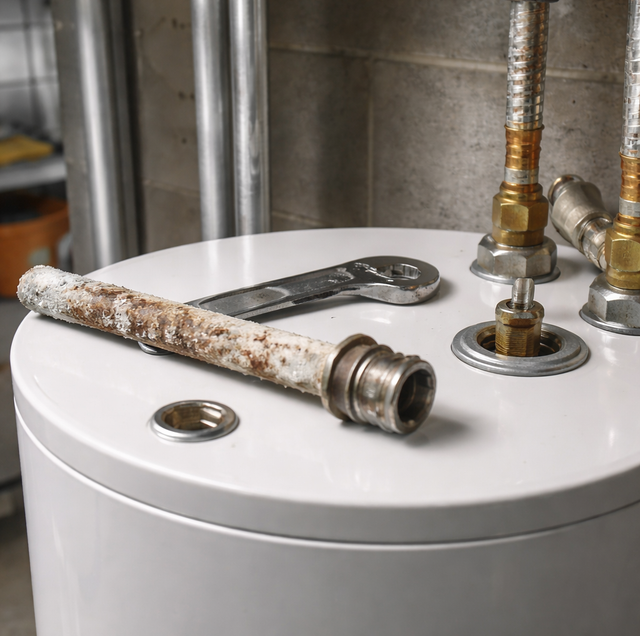
Quick Answer: An anode rod is a sacrificial metal rod inside a tank water heater that corrodes on purpose so the steel tank does not. It should be inspected every two to three years and replaced once it is heavily eaten away. A spent rod is the point at which the tank itself starts to rust.
Most people never look inside a tank water heater until it leaks across the garage floor. By then the steel shell has rusted through, and no repair brings it back. The part that was supposed to prevent that day sits threaded into the top of the tank, quietly wearing away for years: the anode rod. It is the least glamorous component in the whole appliance and the single one most responsible for how long the tank survives.
Sacrificial Protection, Explained First
Before the types and the replacement schedule make sense, one idea has to land: galvanic protection. When two different metals sit in the same water and are electrically connected, one of them corrodes faster, and the other is spared. Which metal loses depends on how chemically reactive each one is. The more reactive metal gives up its electrons first and dissolves, while the less reactive metal is left alone.
A tank water heater is built from steel with a thin glass lining fused to the inside. That lining is never perfect. It has tiny pinholes, and it cracks a little wherever the tank was welded or where a fitting threads in. Bare steel is exposed at every one of those gaps, and hot water is exactly the environment steel rusts in fastest.
The anode rod is a length of metal chosen specifically because it is more reactive than steel. Threaded into the tank and bathed in the same water, it becomes the metal that corrodes. Engineers call it a sacrificial anode because it is sacrificed on purpose. As long as the rod has material left to give, the corrosion attacks the rod instead of the exposed steel. The tank is protected not by paint or coating but by chemistry, and that protection runs continuously without any moving parts.
How the Rod Actually Works
Inside the rod is a steel core wire, and around that core is the sacrificial metal cast in a thick cylinder. The whole assembly screws into a port on top of the heater, usually under a plastic cap, and hangs down through most of the tank's height.
Water conducts a small electric current between the reactive rod and the exposed steel. That current carries metal ions off the rod and into the water, which is corrosion by definition. The exposed steel, sitting on the receiving end of that current, is held in a state where it cannot easily give up its own ions. So it does not rust while the rod still has metal to lose.
This is why a water heater can run for a decade on a lining that was never watertight to begin with. The glass slows corrosion, but the anode is what actually stops the steel from rusting at the gaps. When the rod is finally consumed down to that bare steel core wire, the protection ends, and the tank is on its own.
The Types of Anode Rod
Anode rods come in a handful of materials, and the right one depends on the water and the problem you are trying to solve.
Magnesium: Magnesium is the most reactive of the common choices, which makes it the most protective. It corrodes readily and pushes a strong protective current to the steel, so it is the default for softer water and the material many quality tanks ship with. The trade-off is that in aggressive water it wears out faster, and it is the material most associated with a rotten-egg odor, covered below.
Aluminum: Aluminum is less reactive than magnesium, so it corrodes more slowly and lasts longer in harder water where a magnesium rod would be eaten quickly. It provides real protection at a gentler rate. Aluminum rods tend to swell and get crusty as they age, and a spent one can crumble into sediment at the bottom of the tank.
Aluminum-Zinc: An aluminum rod with a small amount of zinc alloyed in is the go-to when the hot water smells like sulfur. The zinc changes the chemistry at the rod surface enough to interrupt the reaction that produces the smell. It is a targeted fix rather than a general upgrade, chosen for odor rather than for longer tank life.
Powered (Impressed-Current): A powered anode is a titanium rod driven by a small plug-in module instead of a metal that dissolves. It supplies the protective current electrically, so the rod never wears out and never needs replacing. Because it is not consumed and does not react the way magnesium does, it is a common choice for very hard water and for eliminating sulfur odor without swapping rods every couple of years. It needs a working power supply to do its job, which is the one thing a plain metal rod never worries about.
Why It Needs Inspecting Every Few Years
A sacrificial rod is being used up the entire time the heater runs. On a rough schedule, a rod protecting an average household is meaningfully worn in three to five years, and heavy hot-water use or aggressive water shortens that. The number is not fixed, which is exactly why the rod is meant to be checked rather than assumed.
Pulling the rod and looking at it is the only reliable way to know where it stands. A healthy rod still has a solid layer of sacrificial metal over its core. A spent rod is a thin, pitted wire with most of the metal gone, sometimes wrapped in a crusty shell. Inspecting every two to three years catches the rod before it is fully gone and gives a clear signal for when to replace it.
Replacing a worn rod is cheap insurance. Ignoring it is not a neutral choice: once the rod is gone, the tank has lost its corrosion protection, and rust begins working on the steel at every gap in the lining. From there, the countdown to a leak has started, and a leaking steel tank cannot be repaired.
How a Water Softener Speeds Anode Consumption
Softened water and anode rods have an awkward relationship. A softener works by swapping the calcium and magnesium hardness in the water for sodium. The resulting softened water is more conductive and more corrosive toward the sacrificial metal, so it draws material off the rod faster.
The practical effect is that a home on a softener can consume an anode rod in as little as half the time it would take on unsoftened water. That is not a reason to skip the softener, which protects pipes and fixtures elsewhere in the house. It is a reason to inspect the rod more often on a softened system, and it is one of the situations where a powered rod earns its keep, since there is no sacrificial metal for the aggressive water to eat.
The Rod and the Rotten-Egg Smell
A rotten-egg or sulfur smell from the hot water alone, with the cold water smelling fine, usually traces back to the anode rod. The mechanism is biological. Certain harmless sulfate-reducing bacteria can live in a water heater and feed on the hydrogen that a magnesium rod releases as it corrodes. As a byproduct, they produce hydrogen sulfide gas, which is the source of the smell.
Because a magnesium rod feeds that reaction most, switching to an aluminum-zinc rod often quiets the odor by changing the surface chemistry, and a powered rod removes it by taking sacrificial metal out of the equation entirely. Reaching for a smell fix is a good moment also to flush the tank, since sediment gives the bacteria a place to shelter. Because a magnesium rod feeds that reaction most, switching to an aluminum-zinc rod often quiets the odor by changing the surface chemistry, and a powered rod removes it by taking sacrificial metal out of the equation entirely. Reaching for a smell fix is a good moment to also flush the tank, since sediment gives the bacteria a place to shelter.
Safety and When to Call a Plumber
Replacing an anode rod is a real service task, not a casual one. The tank holds scalding water under pressure. Before the rod comes out, the power or gas has to be off, the cold water supply closed, and the pressure relieved by opening a hot tap and draining enough water to drop the level below the port. Skipping those steps risks a burn from hot water or a mess from a tank still under pressure.
The rod fitting is often torqued down hard and locked in by years of corrosion. A stuck rod that will not break loose, or a tank fitting so tight it risks damaging the heater, is a job worth handing to a plumber with the right breaker bar and experience. On a gas unit, the gas control has to be handled correctly when the burner is taken out of service and put back. And there is a judgment call worth making honestly: a very old tank that is already heavily corroded and near the end of its life is often better replaced than serviced, since a fresh anode cannot undo rust that has already thinned the steel.
Frequently Asked Questions
Yes. Some higher-capacity and premium tanks ship with two anodes to cover more steel, and a common upgrade is a combination anode built into the hot-water outlet nipple, which adds a second sacrificial rod without needing a separate port. If a tank has two, both wear down, and both should be checked, not just the obvious one under the top cap.
The tank's model or serial data plate usually notes the factory anode. Once the rod is pulled, the material is visible: magnesium comes out pitted and rough; aluminum tends to be swollen and bent with a crusty coating; and a powered rod is a smooth titanium wire with a wire lead running to a plug-in module on top. If a small module is plugged in near the top of the heater, it already has a powered anode.
They solve different problems. Flushing clears the sediment that settles on the bottom, which protects heating efficiency and, on a gas unit, keeps sediment from insulating the burner from the water above it. The anode protects the steel walls from rust. Doing both together during one service is efficient, but a flush does nothing to restore a spent rod, and a fresh rod does nothing to remove existing sediment.
No. Once a steel tank has rusted through and is leaking, the damage is permanent and a new rod cannot reverse it. The anode only prevents corrosion going forward, so its value is entirely in being maintained before the tank fails. A leaking tank needs replacement, not a new rod.
Most traditional tankless units have no steel tank to protect, so they use no anode rod and rely on other corrosion controls instead. The exception is a hybrid tankless-with-storage design, which does carry a tank and so does use an anode. So the answer depends on whether the unit stores hot water or heats it on demand.
The small amount of metal the rod sheds goes into the water as dissolved ions and settles partly as sediment, which is normal and not a health concern at these levels. An aluminum rod that has crumbled can leave a grayish, gel-like sediment at the tank bottom that some people notice; switching to a different material and flushing the tank clears it.
Have your anode rod checked before it lets the tank rust — a quick inspection can add years to a water heater. Solace Plumbing serves Gilbert and the East Valley. ROC #334000. Call (480) 630-0224.
