Why Is My Shower Losing Water Pressure? 7 Culprits
Quick Answer: A weak shower usually traces to one of a few things: mineral scale clogging the showerhead or its flow restrictor, a worn pressure-balancing cartridge in the shower valve, scale narrowing old galvanized pipes, a partly closed shut-off, or a failing pressure-reducing valve on the house. The fastest test is to unscrew the head and run the arm; if the flow jumps back, the head was the problem.
A shower that used to hit you with a strong spray and now dribbles is telling you something specific, and the fix depends entirely on where the restriction lives. The trick is to stop guessing and start isolating. A clogged showerhead and a failing house valve produce the same weak spray at the wall, but they are worlds apart in what they take to fix, so the first job is figuring out which layer of the plumbing is actually choking the flow.
Work from the fixture outward. The nozzle you can hold in your hand is the easiest and most common cause, and the causes get progressively deeper, harder to reach, and rarer as you move back toward the street. Here is how to read the symptom and trace it to its source.
Start With One Question: One Fixture Or The Whole House
Before you touch the showerhead, answer the question that splits the whole diagnosis into two. Turn on the kitchen sink, a bathroom faucet, and the washing machine, and notice whether they are also weak or perfectly strong.
If every fixture in the house is soft, the problem is upstream of the shower, somewhere in the main supply: a partly closed main valve, a failing pressure-reducing valve, scaled-up main lines, a hidden leak bleeding off supply, or lower pressure coming in from the street. Chasing the showerhead in that case wastes your time, because the head is fine, and the water reaching it is already weak.
If the shower is the only weak spot and everything else runs strong, the fault is local to that shower, which is good news. It means the cause is almost certainly the head, its internal restrictor, or the valve inside the wall, and it stays contained to one repair.
Two more questions sharpen it further. Does the weakness affect hot only, cold only, or both? A drop of just one temperature point on that side's supply or at the valve, while both sides are weak together, points to the head or a shared line. And did it fade slowly over months or drop off suddenly? Slow fade is the signature of scale building up grain by grain; a sudden change points at something that moved or broke, like a cartridge that finally gave out or a valve someone bumped.
The Showerhead: Scale In The Nozzles
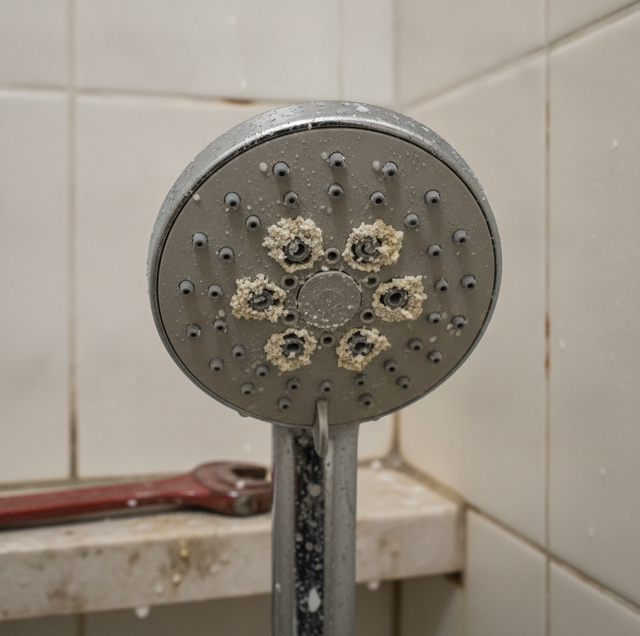
This is the number-one cause in hard-water areas, and the easiest to rule out. The water in many areas is very hard, loaded with dissolved calcium and magnesium. Every time the shower runs and the head dries between uses, a little more of that mineral crystallizes into hard white scale, and it collects exactly where the water exits: the tiny spray nozzles and the internal screen. Enough of them plug up, and the spray weakens, splits into odd sideways jets, or narrows to a few working holes.
The test takes ten seconds. Unscrew the showerhead from the pipe arm and turn the water on with the head off. If a strong, full-bore stream blasts out of the bare arm, you just found your culprit, and it is the friendliest one on this list. The restriction was in the head, not the plumbing.
To clear it, fill a bag or bowl with plain white vinegar, submerge the head so the spray face sits in the liquid, and leave it to soak. The acetic acid dissolves the calcium carbonate scale that plain water cannot budge. A couple of hours handles a light case; a badly crusted head may need an overnight soak, after which you scrub the face with an old toothbrush and poke stubborn nozzles clear. Rubber-tipped nozzles often clean up with a thumb rub alone. Reassemble with fresh thread tape and test. The soak only works on mineral scale, though; if the head is old and physically corroded or the internal plastic is cracked, no amount of vinegar brings it back, and replacement is the move.
The Flow Restrictor Behind The Head
Most modern showerheads have a small plastic-and-rubber flow restrictor tucked just inside the inlet where the head threads onto the arm, sized to cap how much water the head passes. That disc has a small center hole, and small holes are exactly what hard water scales shut first. When the restrictor clogs, the head starves even though the nozzles themselves look clear.
If the bare-arm test runs strongly but the head still dribbles after a vinegar soak, pop the head apart and check the restrictor and the little screen behind it for a crust of scale. Clearing or cleaning it often restores the flow that the soak alone missed. Think of it as a second, hidden filter that scales up on the same schedule as the nozzles.
The Shower Valve Cartridge: When Temperature Swings, Too
Deeper in the wall sits the shower valve, and inside it a cartridge that does two jobs: it mixes hot and cold, and on a pressure-balancing valve, it holds your temperature steady when pressure shifts elsewhere in the house. Cartridges wear out. Internal seals harden, the balancing spool sticks, and the scale works into the mechanism just like it does everywhere else.
A worn cartridge has its own fingerprints. Watch for weak flow paired with temperature that lurches when someone flushes a toilet or starts the washer, since that is the balancing element failing to compensate. Watch for one temperature running weaker than the other, or for a valve that has grown hard to turn or no longer reaches full hot or full cold. When those signs travel together, the head is a red herring, and the cartridge is the suspect. Cartridges are brand- and model-specific, and the valve body stays under pressure until the water is shut off and bled, which is why this is the point where a diagnosis becomes a job for a pro rather than a soak in the sink.
Scale Inside Old Galvanized Pipe
Homes plumbed decades ago with galvanized steel supply lines have a slower, sneakier version of the same mineral problem. Scale and corrosion build up on the inside walls of the pipe itself, and over the years, the usable bore shrinks, much like a straw narrows if you keep coating its inside. A pipe that starts at three-quarters of an inch can close down to a fraction of that, and once it does, no downstream fixture gets full flow, no matter how clean its head is.
The tell here is a house-wide weakness that came on gradually over the years, often worse at fixtures farthest from the main. This is not a soak-and-scrub fix; it is a piping question. If you have an older home and the whole house has slowly gone soft, that history points toward the supply lines, and a plumber can confirm whether the pipe interior is the bottleneck. Do not try to solve it by opening walls or repiping yourself; the point of noticing the pattern is to describe it accurately to someone who can inspect it.
Upstream Culprits: Shut-Offs, The PRV, Leaks, And The Street
When the whole house is weak, several supply-side causes are worth checking in order.
A partly closed valve is the simplest and most overlooked. The main shut-off where water enters the house, or a fixture stop under a nearby sink, can get knocked or left not-quite-open after a repair, throttling flow with no other symptom. Confirm the main is turned fully open before assuming anything worse.
Many homes have a pressure-reducing valve, or PRV, where the supply enters, which tames incoming street pressure to a level the house plumbing likes. Residential water pressure typically sits somewhere in the range of about 40 to 80 psi, and a PRV is usually preset within that band. When a PRV fails, it can drift low and choke the whole house, or fail the other way and run pressure too high. A gauge on an outside hose bib reads what you are actually getting, and a reading well under that normal band points at the PRV or the incoming supply.
A hidden leak is the one to take seriously. Water escaping from a buried supply line or a slab leak bleeds off pressure before it ever reaches your fixtures, so unexplained house-wide weakness can be an early symptom of a leak rather than a clog. Pair it with a running-water sound when everything is off, a warm spot on the floor, or a water bill that climbed with no change in habits, and it is worth an immediate look. Finally, the municipal supply itself can dip; if a neighbor reports the same soft flow at the same time, the cause may be out at the street and out of your hands.
Reading The Pattern
| What you notice | Where to look first |
|---|---|
| Only the shower is weak; other taps are strong | Showerhead, restrictor, or shower cartridge |
| Bare pipe arm blasts strong with head off | The showerhead is scaled up |
| Temperature swings when a toilet flushes | Pressure-balancing cartridge in the valve |
| Whole house weak, came on over the years | Scaled galvanized pipe or a failing PRV |
| Whole house weak, dropped suddenly | Partly closed valve, PRV, or a leak |
Read down the left column to the line that matches your shower, and the right column tells you which layer to check. The pattern does most of the diagnostic work; the repair follows from where the restriction lives.
Frequently Asked Questions
In very hard water, scale can start choking the nozzles again within a few months, so a light soak every one to three months keeps a head from ever crusting over, which is far easier than rescuing one that is fully blocked. Two things stretch that interval: a head with soft rubber nozzle tips you can rub clean by hand sheds scale better than one with hard metal orifices, and an inline shower filter or a whole-home softener slows how fast the minerals redeposit in the first place. Once a head has been cleaned several times and still runs weak, the scale has usually worked into the internal flow restrictor where a soak cannot reach, and swapping in a fresh head is the quicker answer.
They feel similar, but they are different problems. A WaterSense or low-flow head is engineered to limit how many gallons per minute it passes, often to a designed limit, so it delivers a gentler spray on purpose, even with perfect pressure behind it. That is the head doing its job, not a fault. True low pressure is a change from how that same head used to perform, or weakness across multiple fixtures. If the shower has always felt soft since the head went on, you may simply have a low-flow head rather than a pressure problem to chase.
Because the restriction is local to the shower's own hardware. Sinks have their own aerators and short supply runs, so a scaled showerhead, a clogged flow restrictor, or a worn cartridge inside the shower valve knocks down that one fixture while leaving everything else untouched. When one fixture is the odd one out, you can almost always skip the whole-house supply and focus on the parts specific to that shower.
It can, which is why house-wide weakness deserves a second look rather than a shrug. A supply line leaking underground or under the slab bleeds off pressure before it reaches your taps. The corroborating signs are a faint running-water sound when every fixture is off, a warm patch on the floor over a hot-line leak, a spike in the water bill with no change in usage, and damp flooring away from any fixture. Any of those, alongside falling pressure, is a reason to have it located promptly, since a slab leak works on the soil under the foundation the longer it runs.
It can if it is undersized, overdue for service, or clogged. Every filter and softener adds some resistance to the line, and a cartridge filter packed with sediment or a softener with a fouled resin bed or stuck valve chokes flow to the whole house. If your pressure dropped around the time a filter was due for a change, or since a softener was installed, that unit is worth checking first; a system sized too small for the home's demand throttles everything downstream, even when it is working as designed.
They isolate by elimination, the same logic you can start with yourself. Removing the head and running the bare arm separates the head from everything behind the wall; if the arm blasts strong, the head or its restrictor was the problem. If the bare arm is still weak, the fault is upstream in the valve or the supply. From there, the cartridge gives itself away through behavior a clean head never shows: temperature that swings when another fixture draws water, one side weaker than the other, or a handle gone stiff or short of full travel. Those points at the pressure-balancing cartridge, which a pro pulls and inspects after shutting and bleeding the valve.
Have a pro trace your weak shower to its real source and fix it right — no guesswork, no repeat visits. Solace Plumbing serves Gilbert and the East Valley. ROC #334000. Call (480) 630-0224.
