Water Heater Popping or Rumbling? What Each Noise Means
Quick Answer: Most water heater noise comes from sediment settled on the bottom of the tank. As the burner or element heats the tank, water trapped under that mineral layer boils and forces its way up, creating the popping and rumbling. Ticking and tapping are usually harmless expansion. Loud rumbling means the tank needs flushing, and any whistling means the valves and pressure should be checked.
A water heater is supposed to be a quiet appliance. When it starts popping, rumbling, or knocking, most people assume it is about to fail. Usually it is not that dramatic. The vast majority of tank water heater noise traces back to one thing: sediment, and once you understand how the tank heats water, each distinct sound starts pointing to a specific cause worth knowing about. Some of those causes are harmless. A couple of them are the tank telling you it needs attention before a small problem grows into a leak.
How A Tank Heats Water In The First Place
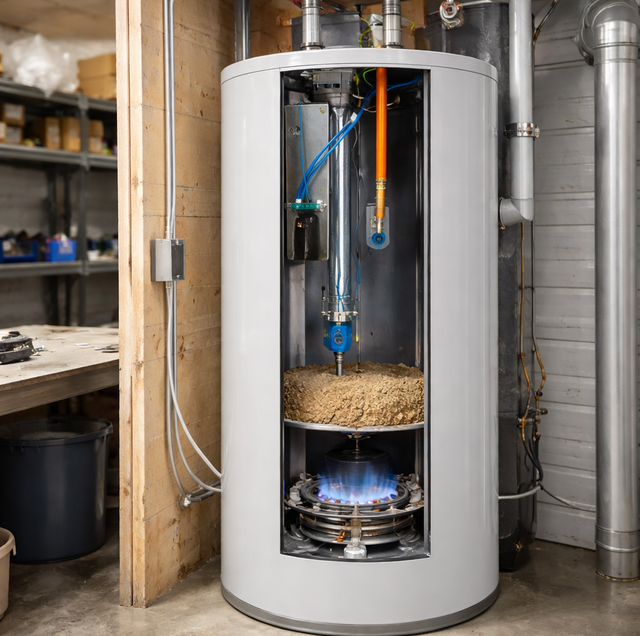
The sounds only make sense once you know where the heat comes from. A tank water heater warms water from the bottom, not the middle or top. On a gas unit, a burner sits underneath the tank and fires up into a chamber below the steel floor. On an electric unit, one or two heating elements screw into the side of the tank and sit submerged in the water, and the lower element does most of the work.
Either way, the coldest, densest water sinks to the bottom, which is exactly where the heat is applied. That water warms, rises, and colder water takes its place. It is a slow churn that runs every time the thermostat calls for heat. The catch is that the bottom of the tank is also where everything else in your water ends up settling. That overlap, heat at the bottom and debris at the bottom, is the reason most of these noises exist.
Why Sediment Is The Core Problem
Water carries dissolved minerals, mostly calcium and magnesium, and the harder your water, the more it carries. When water is heated, those minerals drop out of solution and settle as a gritty scale on the tank floor. Over months and years, the layer thickens into something like coarse sand packed across the bottom.
That layer causes trouble in several ways at once. It insulates the burner or buries the lower element, so heat has to fight through a crust before it reaches the water. The unit runs longer to hit the same temperature, which quietly raises energy use and shrinks how much truly hot water the tank can deliver. The trapped heat also stresses the metal. On a gas unit, the steel floor above the burner can overheat under a thick scale layer, and sustained overheating is what eventually weakens and cracks a tank. Sediment does not just make noise. It shortens the appliance's life.
This is a year-round issue, not a seasonal one. Cold incoming water in winter makes the burner work harder against the scale, and warm incoming water the rest of the year still deposits fresh minerals every heating cycle. The buildup never takes a season off.
What Each Sound Is Trying To Tell You
Different noises come from different mechanisms. Matching the sound to the cause tells you whether to relax or take action.
Popping, Rumbling, And Knocking: This is the classic, and the most common by far. As the tank heats, water gets trapped underneath and inside the sediment layer on the bottom. That water superheats, boils, and forces its way up through the mineral crust in bursts, the same way water percolates in a pot with a crusted bottom. Each burst is a pop; a whole floor of them at once becomes a rumble; a heavy slab of scale shifting as steam lifts it produces a knock or a thud. The louder and deeper the rumble, the thicker the sediment. It is the tank's clearest signal that it is overdue for a flush.
Crackling or Sizzling: On an electric heater, crackling usually means the lower element is partly buried in sediment and is boiling water right against the scale. On a gas unit, a sizzling or frying sound often means condensation is dripping down onto the burner, which is normal in small amounts on a cold tank warming up, but worth watching if it is constant, because a steady drip can point to a tank issue rather than harmless condensation.
High-Pitched Whistling: A whistle is moving water squeezing through a restriction. The usual suspects are a valve that is only partly open, a restricted or scaled-up valve seat, or the temperature and pressure relief valve (the T&P) beginning to weep. A whistling T&P is the one to take seriously, because that valve is a safety device and any sound from it points back to pressure or temperature inside the tank.
Ticking or Tapping: This one is almost always harmless. As metal heats and cools, it expands and contracts, and the pipes, fittings, and the heat-trap nipples on top of the tank tick against their surroundings as they move. It follows the heating cycle, is light and rhythmic, and signals nothing wrong. If the only sound you hear is a soft tick after the unit runs, there is nothing to fix.
Banging or Hammering After A Tap Shuts: If the bang happens the instant you close a faucet or the washing machine valve snaps shut, the heater is not the culprit. That is water hammer, a shockwave that runs back through the pipes when fast-moving water is stopped suddenly. It shows up near the heater because the tank and its connections are a convenient place for the whole system's pressure to echo. The fix lives in the plumbing, not the tank.
Screeching: A sharp, thin screech is water forcing past a valve that is not fully open, most often the cold-water inlet valve or a supply stop that was never opened all the way. Opening the valve fully usually ends it.
Which Noises Are Fine And Which Need Action
Sorting them into two piles keeps this simple.
Harmless, no action needed: light ticking and tapping from expansion, and a brief sizzle on a cold gas unit as it first warms up. These follow the heating cycle and stay quiet.
Worth acting on: loud popping or a deep rumble means heavy sediment and a tank due for flushing. A whistling or weeping T&P valve means the pressure and temperature should be checked without delay. Persistent crackling on an electric unit points to a buried element. Banging after a tap closes means the pressure system needs a water hammer fix.
The Fixes That Actually Address The Cause
Flush the tank on a schedule: Draining and flushing clears the sediment that causes most of the noise and most of the efficiency loss. Once a year is a reasonable baseline, and harder water calls for more often, sometimes twice a year. A flush that comes out gritty and cloudy tells you it was overdue.
Check the valves and the T&P: A partly closed valve or a weeping relief valve is a quick thing for a plumber to inspect and correct. The T&P in particular should be verified rather than ignored.
Add an expansion tank for hammer and pressure: If banging after a tap shuts is the problem, or if system pressure runs high, a properly sized expansion tank and, where needed, a pressure-reducing valve give the pressure somewhere to go and stop the shock.
Flushing is not entirely a casual job. The water coming out is scalding, and on a gas unit the work happens right around the burner and pilot, so the gas has to be off or set to pilot and the tank given time before you start. On an electric unit, the power must be cut at the breaker first, because running an element in a partly drained tank can burn it out in seconds. A safety valve is never something to silence by capping or plugging it.
The water coming out during a flush is scalding, and on an electric unit the power must be cut at the breaker first, because running an element in a partly drained tank can burn it out in seconds. A safety valve is never something to silence by capping or plugging it. If a T&P is whistling or discharging, that is a signal of dangerous pressure or temperature, and blocking it risks a tank rupture.
When To Call A Plumber
Call when the rumble is loud, and the tank has never been flushed; when a flush you attempt runs slow or comes out packed with scale; when the T&P weeps or discharges; when crackling on an electric unit does not clear after a flush; or when banging persists after you have ruled out a simple valve. And if you ever smell gas near the unit, do not troubleshoot anything; leave the home and call the gas utility. A plumber can flush safely, test the pressure, replace a failing element or valve, and tell you whether a noisy older tank has enough life left to be worth keeping.
Frequently Asked Questions
A partial approach some homeowners try is draining a few gallons from the drain valve at the bottom every couple of months, which pulls out loose grit before it packs down hard. It will not remove a thick, cemented layer that needs a full flush and sometimes a de-liming, but on a newer tank the short monthly draw-off can keep scale from ever building up enough to make noise.
A tankless unit has no bottom sediment layer to boil, so it will not pop or rumble the same way. It can still develop scale inside its heat exchanger, which shows up as reduced flow, fluctuating temperature, or a rattling sound, and it is cleared by a vinegar descaling flush rather than a tank drain. Manufacturers such as Rinnai and Navien specify descaling intervals in the owner's manual.
Softened water carries far less of the calcium and magnesium that forms scale, so a softener slows sediment buildup considerably and is one of the better long-term defenses in hard-water homes. It does not eliminate flushing, since a softener needs upkeep and no system removes every mineral, but it stretches the interval between flushes and eases the strain on the tank.
There is no single number, but once scale builds past roughly an inch across the floor of a gas unit, the steel above the burner can no longer shed heat well and starts to overheat in that spot. Sustained overheating is what warps and eventually cracks the glass lining, so a heater that has rumbled loudly for years without a flush is the classic candidate for a bottom failure.
A jump in noise often follows a change in the water or a maintenance event. A new water heater is quiet until enough scale accumulates to trap water, which can take a couple of years. A sudden increase can also follow a nearby water main repair that stirred sediment into the supply, or a rise in incoming water hardness. If it began right after plumbing work, air trapped in the lines can also gurgle for a day or two before clearing on its own.
It can. A higher temperature setting drives faster mineral drop-out and more vigorous boiling under the sediment, so turning a tank up to a very hot setting tends to make an already-scaled unit louder. Keeping the setting moderate slows scale formation, saves energy, and reduces scald risk at the tap, without leaving water uncomfortably cool.
Get that noisy water heater diagnosed before a small rumble turns into a leak — a flush or a valve check often quiets it for good. Solace Plumbing serves Gilbert, Mesa, and Chandler. ROC #334000. Call (480) 630-0224.
