
When Does a House Actually Need Repiping? 6 Signs It's Time
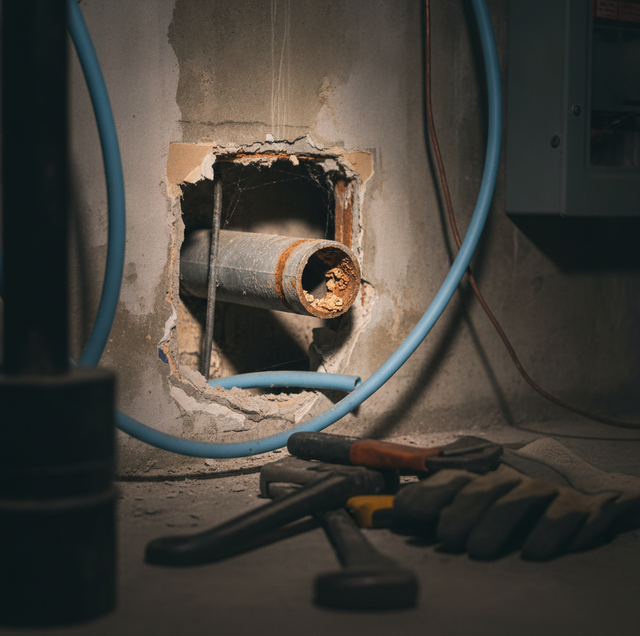
Quick Answer: A house needs repiping when the pipe material itself is failing, not just when one section springs a leak. The clearest triggers are repeated pinhole leaks in the same original piping, corroding galvanized steel or failure-prone polybutylene in the walls, rusty water traced to the supply lines, and pressure that stays weak because scale has narrowed the pipes. A single leak in an otherwise sound pipe is a spot repair. A pattern of failures across an aging system is a repipe.
Repiping means replacing the pipes that carry water through a house rather than patching individual failures one at a time. Most of the time, it applies to the supply lines, the pressurized pipes that bring clean water to every fixture, and sometimes it extends to the drain lines that carry waste away. The distinction that matters is this: a plumber can cut out a bad section and splice in new pipe when a single spot fails, but at some point the pipe itself is the problem, and no number of splices will fix a material that is failing everywhere at once.
Knowing which situation you are in saves money and frustration. This piece walks through how the supply pipe actually fails, the signs that point to a full repipe rather than another spot repair, and what the job looks like when warranted.
How Supply Pipe Fails From the Inside
To understand when replacement makes sense, it helps to picture what happens inside a pipe over decades. Water is not inert. It carries minerals, oxygen, and sometimes a slightly acidic or alkaline balance that slowly reacts with whatever the pipe is made of. The failure happens on the inside surface, where you cannot see it, which is why the outside of a pipe can look fine right up until it leaks.
Think of an old supply line the way you would think of an artery that has been narrowing for years. The walls thicken with deposits, the opening shrinks, and the material itself grows brittle and pitted. A blockage or a rupture is not a sudden event so much as the last stage of a long, quiet process. By the time you notice symptoms at the faucet, the interior of the pipe has usually been deteriorating for a long while.
Different materials fail in different ways, and the material in your walls is one of the biggest factors in whether you are looking at a repair or a replacement.
The Pipe Materials That Usually Trigger a Repipe
Galvanized steel was standard in older homes. It is steel coated in zinc, and once that zinc coating wears through, the steel underneath corrodes. Rust builds up on the inside wall, the passage narrows, and flakes of corrosion break loose into the water. Galvanized pipe tends to fail gradually and then all at once across the whole system, because every run of it is the same age and the same chemistry.
Polybutylene is a gray plastic pipe used in many homes built from the late 1970s into the mid-1990s. It became known for failing without much warning, sometimes at the fittings and sometimes along the pipe itself. Because the failures can be sudden and are difficult to predict, polybutylene is one of the most common reasons a home gets repiped, often as a preventive measure before a rupture rather than after one.
Copper is durable and has been used for generations, but it is not immune. Older copper can develop pinhole leaks, tiny perforations that form from the inside out, often in clusters. When one pinhole in a copper system is followed by another and then another, it is a signal that the whole run of copper is reaching the same stage of wear at roughly the same time.
Signs That Point to a Repipe Instead of a Spot Repair
No single symptom decides it. Plumbers weigh several factors together, and the picture they form is what separates a systemic failure from a one-off.
Frequency and spread of leaks: One leak is a repair. When leaks keep appearing in the same original piping, in different spots, over a fairly short span, the pattern itself is the diagnosis. You are no longer fixing a defect; you are chasing a material that is giving out.
The pipe material: Galvanized steel and polybutylene both carry a known tendency to fail across the system rather than in one place. If either is in your walls and showing symptoms, replacement usually makes more sense than piecemeal repair.
Water quality: Rusty, brown, or metallic-tasting water that clears from the water heater but keeps coming from the cold supply lines points to corrosion in the pipe upstream of the fixtures. Discoloration coming from the pipe walls is a sign that the supply lines are wearing thin.
Pressure and flow: Water pressure has dropped throughout the house, not just at one fixture, and it stays low no matter what you clean or replace at the fixture end, suggesting the pipes themselves have narrowed with scale and deposits.
A few specific situations tend to tip the decision as well. A slab leak in an older system often means more are coming, because the pipe under the slab is the same age everywhere. Water that has been shut off and restored repeatedly for recurring problems is a system asking to be replaced. And a whole-house remodel is a natural moment to repipe, since walls are already open and the disruption is already happening.
Repair or Replace: Drawing the Line
The honest way to frame the choice is cost over time, not cost today. Patching a single leak in the sound pipe is the right call, and repiping a whole house because of one isolated failure would be overkill. The line gets crossed when the repairs stop being isolated.
If a plumber is returning to the same aging system to fix a second or third failure, the arithmetic shifts. Each patch has a cost, each one comes with wall access and cleanup, and none of them addresses the reason the pipe keeps failing. At that point, continuing to patch usually costs more over the life of the system than replacing the pipe would, and it leaves you living with the uncertainty of the next leak. A repipe ends that cycle by removing the failing material entirely.
What a Repipe Actually Involves
For supply lines today, the two common materials are copper and PEX. Copper is rigid, long-proven, and joined with soldered or pressed fittings. PEX is a flexible plastic tubing that has become widely used because it resists corrosion and scale, bends around obstacles, and can be routed through walls with fewer connections. Neither is automatically better; the right choice depends on the home's layout, the local water, and preference.
The job is less destructive than most people picture. A plumber maps the runs, then cuts small access openings in the walls and ceilings where the new pipe needs to pass. The old lines are abandoned or removed, and the new system is run, connected, pressure-tested, and put into service. A whole-house repipe is often completed in a few days, after which the access openings are patched. It is real work, but it is not a demolition.
Repiping is a licensed plumber's job from start to finish. It involves shutting down and reconnecting the water supply for the entire home, meeting code on materials and connections, and pressure-testing the finished system before the walls close up. This is not a DIY project, and it is worth having done by a licensed professional who can size the pipe correctly and stand behind the work.
Frequently Asked Questions
There is no single magic number, but a plumber does not have to guess. A pressure test or a camera run, plus a check of the remaining pipe wall thickness, shows whether the material still has life in it. A water test that reads aggressive, low-pH water often explains why one section after another keeps giving out, since the chemistry is eating every run at once. When those readings line up with repeat leaks, the decision tips toward replacing the pipe rather than chasing the next patch.
You can often spot the troublesome materials yourself before a plumber names them. Polybutylene is dull gray plastic, sometimes blue or black, joined with crimped fittings, and it tends to fail at those fittings. Galvanized is dull silver-gray metal, and it rusts at the threaded joints first, so that is where you will see staining or weeping. Each material carries a known weak point, which is why identifying what is in the walls is such a big part of the repair-or-replace call.
It is less disruptive than people picture. The water usually goes off only for short stretches during the tie-ins, not for days, and crews work room by room, so most of the house stays usable while one area is open. The drywall patching and texture are commonly handled as a separate finishing step after the new pipe passes inspection, so the access openings sit briefly before they are closed and blended back in.
Where and how the lines run factor into the pick as much as the material itself. PEX should not be run in direct sunlight, since UV light degrades it over time, and rodents can occasionally chew through it in exposed spots. Copper handles high heat well and holds up outdoors, so it tends to win for exterior or sun-exposed runs. Inside protected wall cavities can serve either purpose, which is why the routing, not just a ranking of the two materials, drives the choice.
Not always, but it can. If the rust is coming from corroding galvanized supply pipes rather than just the water heater, it means the pipe walls are deteriorating from the inside and shedding corrosion into the water. That is a classic sign that the supply lines are nearing the end of their life. A plumber can trace whether the color originates at the heater or in the supply runs themselves.
Sometimes. When old galvanized pipe has scaled shut so far that pressure and flow are chronically weak throughout the whole house, cleaning will not restore it, because the deposits are bonded to and part of the narrowed passage. Replacing the constricted pipe is what brings the flow back, so persistent whole-house pressure loss in old galvanized piping can be reason enough on its own.
Schedule a repipe assessment — get a clear read on whether your pipes need replacing or just a repair. Solace Plumbing serves Gilbert and the East Valley. ROC #334000. Call (480) 630-0224.
